

What Anime Audiences Reveal About the Failure of Feminist Media Theory
I studied media at university. We were taught to analyze stories through representation: Who has agency? Who speaks? Who is shown as desirable? Who controls the camera? Are women subjects, or merely objects for the male gaze?
The framework appeared rigorous because it had vocabulary, citations and measurable tests.
The most famous is the Bechdel test (famously mocked by Rick and Morty). A film passes when it contains at least two named women who speak to each other about something other than a man.
The test was never supposed to measure everything. Yet its underlying logic became deeply embedded in institutional media analysis: more women speaking to other women, more female leads, less sexualization and more independent female agency are treated as evidence that a story is more inclusive or “female-friendly.”
That logic sounds reasonable until we compare it with what women actually watch.
The anime data creates a serious problem
A Japanese audience map published by Nikkei Entertainment! using GEM Partners research (written in Japanese) plotted entertainment properties by the age and gender of their self-identified fans. The underlying survey covered Japanese people aged 15–69, and the chart’s horizontal axis represented the male–female split.
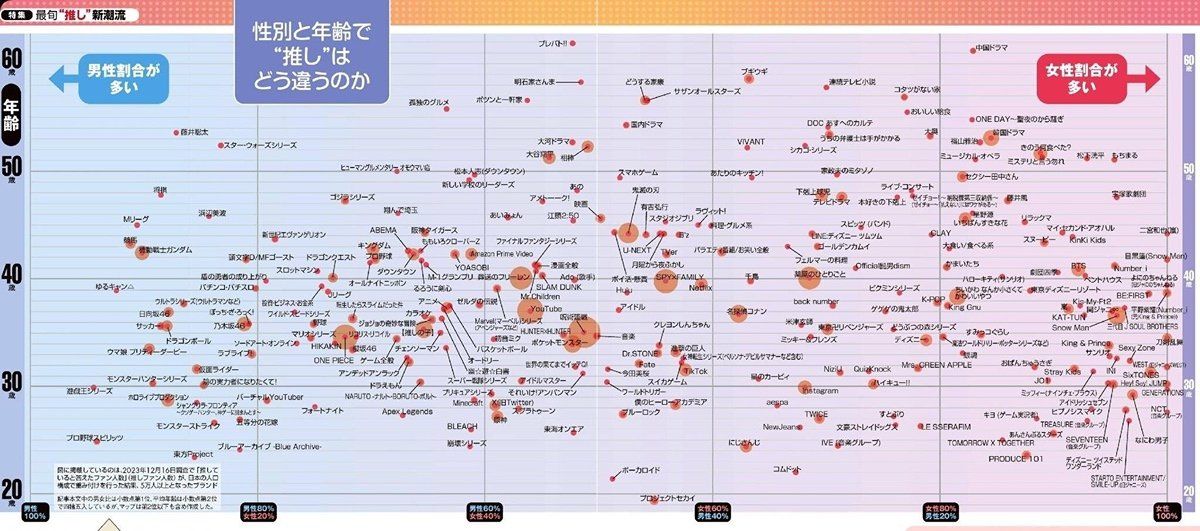
A widely circulated rounded interpretation of the anime portion looked approximately like this:
| Anime | Women | Men |
|---|---|---|
| Gintama | 90% | 10% |
| Haikyuu!! | 80% | 20% |
| Bungo Stray Dogs | 80% | 20% |
| Detective Conan | 70% | 30% |
| Golden Kamuy | 70% | 30% |
| Demon Slayer | 60% | 40% |
| Attack on Titan | 60% | 40% |
| Dungeon Meshi | 60% | 40% |
| Frieren | 50% | 50% |
| Jujutsu Kaisen | 50% | 50% |
| One Piece | 30% | 70% |
| JoJo’s Bizarre Adventure | 30% | 70% |
| Dragon Ball | 20% | 80% |
| Yuru Camp | 10% | 90% |
| Gundam | 10% | 90% |
The precise percentages should not be treated as audited audience shares. They are rounded readings of a scatterplot, and GEM’s measure concerns enthusiastic “oshi” fans rather than every casual viewer.
But the directional pattern is too large to ignore.
Haikyuu!! is about male volleyball players. Almost every important player is male. Most of the dialogue is between boys. Their goals concern competition, training, victory, rivalry and teamwork.
By the standard representation checklist, it should be a male-oriented story.
Its enthusiastic fan base is reportedly overwhelmingly female.
Gintama is even stranger. It is a Shōnen Jump series filled with samurai, gangsters, violent men, political factions, toilet jokes, sexual jokes, gambling and adult men acting like complete idiots.
It looks like something created for Japanese dudes.
Yet the chart places it at the extreme female end.
Then consider the reverse case: Yuru Camp.
The central cast consists almost entirely of girls. They have independent interests, friendships and conversations. Men do not control their lives. The story is not primarily about pursuing male approval.
It should perform extremely well according to a representation-based definition of female-friendly media.
Its enthusiastic fandom appears to be overwhelmingly male.
This is not a small anomaly. It exposes a basic analytical failure:
The gender represented on screen does not reliably predict the gender consuming the story.
Media theory confused representation with desire
Feminist media theory was often good at counting who appeared on screen.
It was much weaker at explaining whom audiences wanted to watch.
Those are not the same question.
Current representation research continues to count female characters, leads, speaking time, sexualized clothing and objectification. For example, the Geena Davis Institute’s 2024 film study found that women represented 37.8% of characters and 35.3% of leads in the films it analyzed. It recommends creating deeper relationships between female characters and explicitly suggests using the Bechdel test as a starting point.
That data can describe the demographic composition of fictional worlds. It can also reveal unequal employment opportunities for actresses and writers.
But it cannot tell us what women will enjoy.
A story can fail the Bechdel test and attract mostly women. Another can pass easily and attract mostly men. Academic researchers themselves have described the Bechdel test as a popular but flawed measure, and empirical work has found that films with poor female representation can remain highly popular and commercially successful.
The missing variable is the position occupied by the viewer.
Media analysis often assumes that women primarily want to identify with women.
Actual audience behaviour suggests that women also want to:
- admire men;
- desire men;
- choose favourite men;
- observe male friendship and rivalry;
- interpret emotional bonds between men;
- watch attractive men suffer, fail, improve and reveal vulnerability;
- become attached to a group of differentiated male personalities.
A woman watching Haikyuu!! does not necessarily require a female volleyball player through whom she can enter the story.
She can enter as the spectator.
She can like Hinata’s optimism, Kageyama’s intensity, Oikawa’s charisma, Tsukishima’s detachment or Bokuto’s emotional instability. She can choose among them. She can become invested in their rivalries, failures and relationships.
The men are not merely identification vehicles for male viewers. They are also objects of female attention.
That sounds obvious when stated directly. Yet a great deal of media theory was built around the assumption that the politically meaningful viewer position was identification with a representative of one’s own demographic group.
An all-male story can be extremely female-oriented
The mistake is especially clear with Haikyuu!!.
It has very little female representation. But it offers women something a mechanically gender-balanced cast may not provide: a dense collection of attractive, emotionally legible and sharply differentiated male characters.
The players are not generic masculine heroes.
Some are confident. Some are insecure. Some are beautiful. Some are socially awkward. Some are disciplined. Some are childish. Some are talented but psychologically fragile. They form friendships, rivalries, mentor relationships and emotionally intense competitive bonds.
From a female fandom perspective, this variety matters more than whether 50% of the team is female.
Gintama works similarly.
Its men are simultaneously ridiculous and admirable. Gintoki is lazy, financially irresponsible and vulgar, but becomes competent and protective when something important is at stake. Hijikata is disciplined and emotionally restrained. Okita is playful and sadistic. Katsura is dignified and completely insane. Takasugi is beautiful, dangerous and tragic.
The viewer gets a catalogue of male personalities and relationships.
The stupid humour is not necessarily an obstacle to female appeal. It humanizes the men. It allows them to be humiliated without losing their deeper attractiveness. The contrast between “useless idiot” and “reliable when it matters” may be more compelling than a permanently polished prince.
The yakuza, samurai and political-faction material is also not inherently male-only. Those settings produce loyalty, hierarchy, betrayal, sacrifice, uniforms, rival groups and emotionally intense male bonds.
Women may like the same subject matter for different reasons than men. Or they may simply like it for many of the same reasons.
Female characters do not automatically create a female viewpoint
The reverse is equally important.
A show filled with girls may be designed around male spectatorship.
Yuru Camp gives male viewers a peaceful world of cute, pleasant and socially safe girls. The audience may not be invited to become those girls in any deep political sense. It may be invited to observe them, relax around them and become affectionately attached to them.
The girls have agency. They speak to one another. They pursue their own interests. The show would easily satisfy many formal representation criteria.
It is still apparently far more popular among men.
This means “female agency” itself cannot predict the audience.
Momo in Dandadan is another useful example. She is confident, socially capable, physically powerful and willing to take the lead with an unpopular nerdy boy. Girls may identify with her as the chooser: a woman who recognizes loyalty and courage in a boy before the broader social world recognizes his value.
At the same time, the premise obviously serves a male fantasy. An attractive, confident girl discovers the hidden worth of an awkward nerd and pulls him into friendship, adventure and romance.
The same character can provide female aspiration and male desire simultaneously.
That is how successful popular culture usually works. It offers several audience positions at once.
Academic feminism was making a normative argument
The most charitable interpretation is that feminist media theory was never really trying to predict audience demand.
It was making a political argument about how women ought to be represented.
That is legitimate.
There is a reasonable distinction between saying:
“Women enjoy this story.”
and:
“This story depicts women narrowly.”
Both statements can be true.
A female-majority audience does not prove that every aspect of a story is free from sexism. Women can enjoy sexualized women, unequal fictional relationships or male-dominated worlds. Enjoyment does not equal political endorsement.
The credibility problem begins when the theory moves from normative criticism to empirical claims about women:
- Women feel excluded by male protagonists.
- Women require female characters for relatability.
- Sexualized heroines alienate female audiences.
- Male-centred action stories are produced only for men.
- A story with insufficient female dialogue is not friendly to women.
Those claims can be tested.
Anime audience behaviour frequently contradicts them.
The typical escape is to argue that women have internalized patriarchy. If women reject male-oriented media, that demonstrates exclusion. If women enthusiastically consume it, that demonstrates ideological conditioning.
That framework cannot lose.
And a theory that cannot lose also cannot learn.
The Bechdel test answers the wrong question
The Bechdel test asks whether women exist as conversational subjects independently of men.
That can be useful when studying thousands of films. If an entire industry repeatedly imagines soldiers, doctors, politicians, workers and background citizens as male, the aggregate pattern is worth examining.
But people turned a corpus-level observation into an artistic quality test.
A film about a male monastery may reasonably fail. A story about an all-male military unit may fail. Haikyuu!! will perform poorly under similar dialogue-based logic because the institution being portrayed is a boys’ volleyball team.
None of that tells us whether women will like the story.
The Bechdel test measures a property of the text.
It does not measure:
- female enjoyment;
- female desire;
- emotional attachment;
- character attractiveness;
- fandom intensity;
- commercial demand;
- narrative quality;
- or even whether a particular female character is well written.
A film can pass because two poorly developed women briefly discuss a sandwich.
A story can fail while providing women with ten male characters they passionately care about for a decade.
Calling the first more female-friendly may satisfy an institutional checklist. It does not describe revealed preference.
The better model
We should separate at least four different questions.
Representation: Who appears and speaks?
Ideology: What does the story imply about gender and power?
Viewer positioning: Is the viewer invited to identify with, desire, admire, protect or interpret the characters?
Revealed audience preference: Who actually watches, pays, returns and becomes a fan?
Feminist media analysis concentrated heavily on the first two.
Popular success depends greatly on the latter two.
The variables can align. Barbie gave women female representation, political recognition and a story explicitly organized around female social experience. Women strongly supported it.
But the variables do not have to align.
Haikyuu!! gives women almost no demographic representation but enormous character attachment.
Gintama gives them a male world filled with emotionally consumable men.
Yuru Camp gives men a female world designed for affection and comfort.
One is not more authentic than the other.
Women are not required to consume fictional versions of themselves. They are allowed to look outward.
What creators should learn
The practical lesson is not that female representation is bad.
It is that adding women is not a substitute for understanding women.
A creator who wants a female audience should not begin with:
“How many female characters do we need?”
The better questions are:
- Are there multiple compelling characters women can choose among?
- Are the male characters emotionally legible?
- Do competence and vulnerability coexist?
- Are the relationships dense enough to interpret?
- Does each character have a recognizable emotional contradiction?
- Does the story create attachment, not merely plot progression?
- What position does the female spectator occupy?
Likewise, a story does not become male-oriented merely because it has a male hero, violence, cars, sports or crude humour.
Subject matter does not determine audience gender nearly as cleanly as critics imagine.
The emotional architecture matters more.
Media theory became detached because it did not have to predict anything
This may be the deepest problem with the media education I received.
We learned how to criticize a successful work after it succeeded.
We did not have to predict who would like it.
We did not have to create anything people voluntarily wanted.
We did not have to explain why women loved stories that our framework classified as male-centred.
We could always reinterpret contradictory evidence as ideology.
That produces intellectual confidence without market accountability.
A better cultural analysis would make predictions before seeing the audience data:
- Which sex will skew toward this story?
- Which character will become popular with women?
- Is the audience identifying with the protagonist or desiring him?
- Will adding a female lead broaden the audience or reduce the character-selection appeal?
- Does the story offer mastery, attachment, aspiration, desire or comfort?
Then we could compare the model with reality.
The anime data does not prove that sexism is nonexistent. It proves something more specific and more damaging to simplistic media theory:
Representation is not preference.
A story can be almost entirely about men and belong culturally to women.
A story can be almost entirely about women and be consumed mainly by men.
Until media criticism takes that distinction seriously, it will continue describing the stories it believes women ought to want rather than understanding the stories women actually choose.