
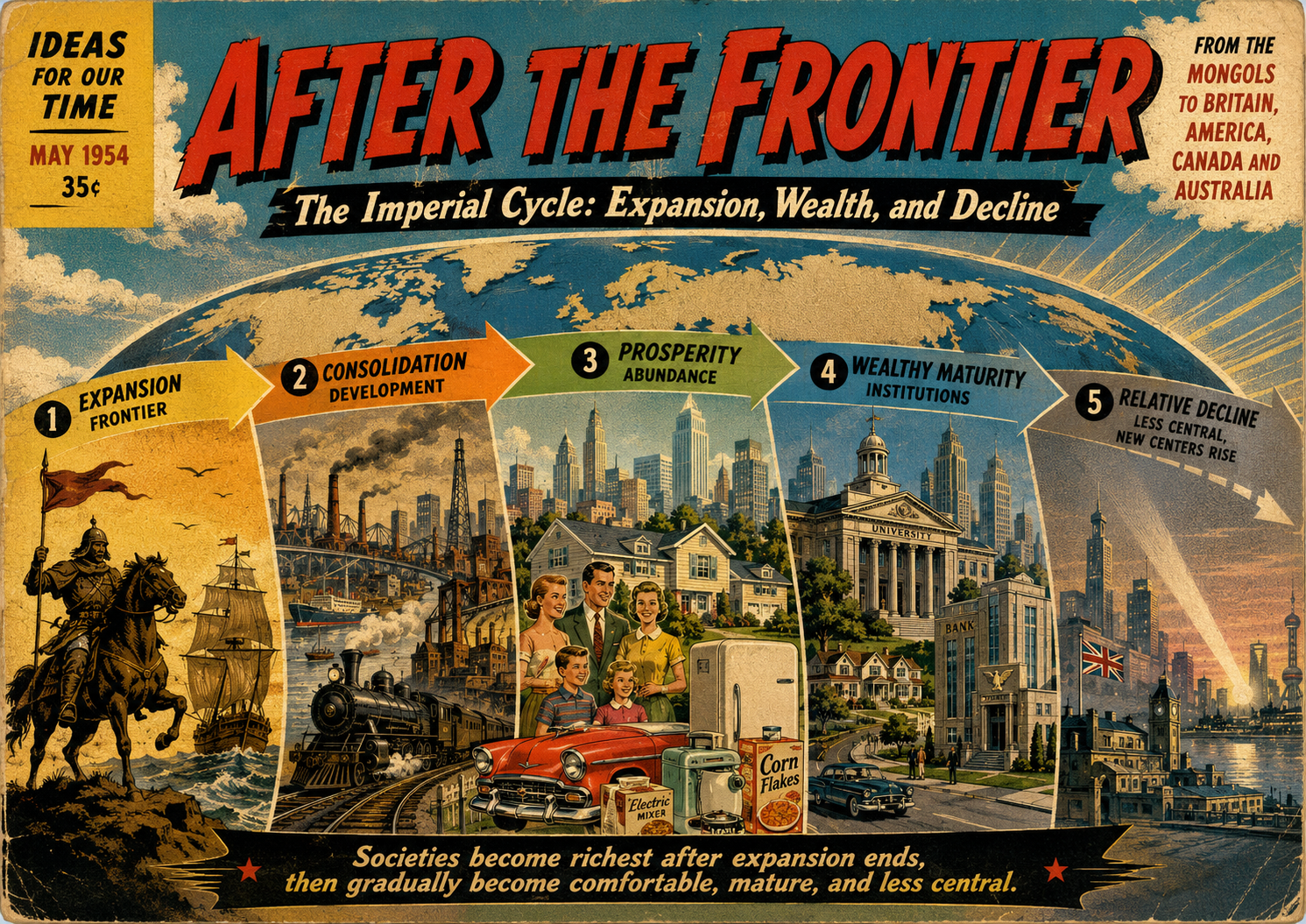
I started thinking about this after watching Jaadugar: A Witch in Mongolia.
What struck me was not the anime itself, but the world behind it.
Eight hundred years ago, the Mongols were not a peripheral people. They were one of the central forces of Eurasian history. Mongol armies and successor states stretched from China across Central Asia and into Persia, connecting enormous parts of the continent under a political and military system that contemporaries could hardly ignore.
Today, Mongolia is a small country between Russia and China, and the Mongol world is mostly encountered as history.
That contrast interested me.
How does a civilization go from being one of the great expansionary forces of its age to becoming peripheral to the world system?
From there I started looking at other civilizations that once seemed almost unstoppable: the Ottoman Turks, Portugal and Spain, Russia, and eventually Britain.
The pattern I became interested in was not simply “empires rise and fall.” That is too vague.
It was something more specific:
What happens after a civilization reaches the end of its geographic frontier?
Across several very different empires, a rough pattern appears:
frontier expansion → consolidation → prosperity → wealthy stagnation → relative decline → possible contraction or reinvention
The surprising part is that the end of expansion often does not immediately produce decline.
Frequently, the civilization becomes richest shortly before or after its frontier closes.
The decline comes later.
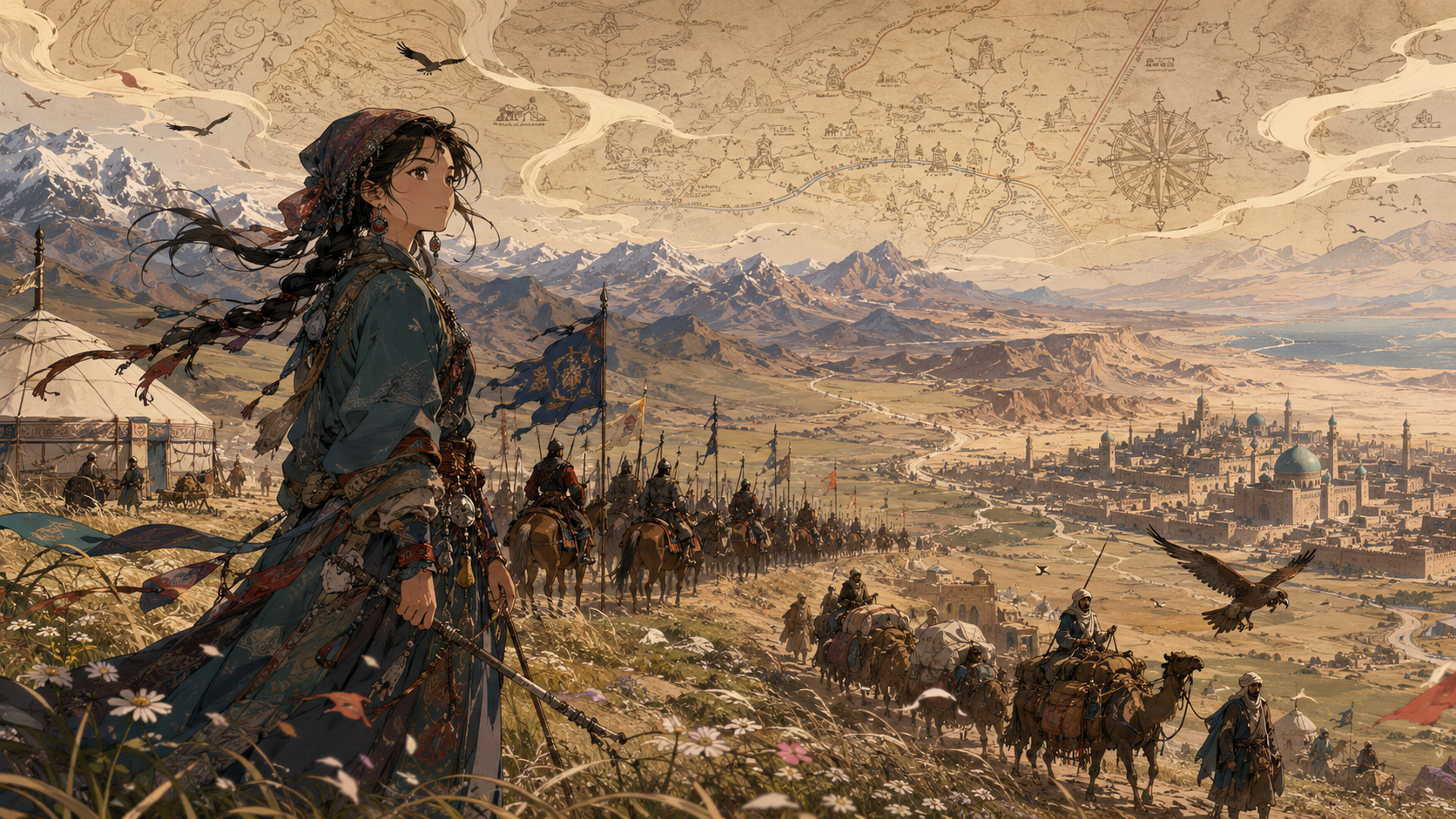
The Basic Cycle
| Stage | What the society is doing | Economic effect | Typical social character |
|---|---|---|---|
| 1. Expansion | Exploring, conquering, settling, opening trade routes, acquiring resources | New land and assets enter the system rapidly | Mobile, ambitious, risk-taking |
| 2. Early consolidation | Railways, ports, cities, mines, farms, factories, administration | Very high returns from developing recently acquired territory | Rapid capital accumulation |
| 3. Prosperity / peak | Newly built system reaches high productivity | Broad wealth growth; often the civilization's golden age | Confidence, rising living standards |
| 4. Wealthy stagnation | Maintaining existing assets and institutions | Still rich, but incremental growth slows | Asset protection, credentials, inheritance, regulation |
| 5. Relative decline | Younger systems compound faster | Country remains wealthy but loses global rank | Nostalgia, status anxiety, elite internationalization |
| 6. Drop / contraction | Capital stock, institutions or political structure begin deteriorating | Can become absolute rather than merely relative decline | Regional decay, emigration, fiscal stress, political restructuring |
The key mistake is to imagine that:
frontier closes → decline begins immediately.
Historically it often looks more like:
frontier closes → development boom → prosperity → long plateau → decline.
The golden age is often the harvest from the preceding expansion.
Historical Examples
The exact dates are debatable, but the broad comparison is more useful than pretending that every empire followed an identical calendar.
| Civilization | Main expansion | Peak / early consolidation | Wealthy mature phase | Clear relative decline or contraction |
|---|---|---|---|---|
| Portugal | ~1450–1550 | ~1500–1580 | late 1500s | ~1600 onward; later partial recoveries |
| Spain | ~1490–1570 | ~1500–1600 | late 1500s–early 1600s | 1600s onward relative to northern Europe |
| Ottoman Empire | ~1300–1600s | ~1450–1600 | ~1600–1700s | increasingly evident from 1700s–1800s |
| Russia | ~1500–1900 | late 1800s–mid 1900s | Soviet industrial consolidation, ~1930–1970 | stagnation ~1970s–80s; breakup 1991 |
| Britain | ~1600–1914 | ~1815–1914 | ~1900–1950 | major relative decline ~1920–1970; post-imperial stabilization thereafter |
| France | repeated expansion; last major colonial phase ~1830–1914 | late 1800s–early 1900s | early–mid 1900s | imperial contraction after 1945; wealthy post-imperial state afterward |
| United States | ~1776–1900 | ~1870–1950 | ~1945–2000 | potentially entering mature post-peak phase now |
| Canada | ~1867–1910 | ~1900–1960 | ~1945–2000 | potentially entering mature post-peak phase now |
| Australia | ~1800–1900 | ~1850–1950 | ~1945–2000 | potentially entering mature post-peak phase now |
These dates should not be interpreted mechanically.
The more important observation is the shape.
Portugal, Spain, the Ottomans and Russia all eventually transitioned from:
adding new territory
to:
developing and maintaining an enormous inherited territorial stock.
For some time, this produced prosperity.
Eventually maintaining the accumulated system became more important than extending it.
Why Prosperity Often Comes After Expansion
Imagine a country that has just acquired enormous territory.
Initially much of it is economically underdeveloped.
It possesses:
- farmland that is not fully cultivated;
- mineral deposits that are not yet mined;
- rivers without dams;
- settlements without railways;
- cities that have barely begun growing;
- forests and energy resources;
- new ports and trade routes;
- populations that have not yet been fully integrated into national markets.
The next generation therefore does not need to conquer anything.
It can simply develop what the previous generation acquired.
So the economic sequence becomes:
territorial accumulation
→ infrastructure
→ capital accumulation
→ urbanization
→ industrialization
→ mass prosperity
This is why maximum territorial expansion and maximum prosperity do not necessarily occur at the same time.
The expansion creates the asset base.
The consolidation phase monetizes it.
The Three Parts of the Post-Frontier Period
The most useful distinction is probably not between expansion and decline.
It is between three different kinds of consolidation.
1. Prosperous Consolidation
This is the best part of the cycle.
The frontier has mostly closed, but there is an enormous amount left to build.
The society invests heavily in:
railways
roads
electricity
housing
factories
ports
universities
mines
industrial cities
Capital per person rises quickly.
Real wages rise.
The middle class expands.
Ordinary people feel that each generation will have more than the previous one.
This often becomes the era later remembered as the country's golden age.
2. Wealthy Stagnation
Eventually most of the obvious development has already happened.
The country now owns an enormous accumulated stock:
houses
infrastructure
companies
financial wealth
universities
pensions
public institutions
industrial systems
The political economy changes.
A younger society asks:
What can we build?
A mature wealthy society increasingly asks:
How do we protect and divide what already exists?
The marginal dollar increasingly goes toward:
| Earlier consolidation | Mature consolidation |
|---|---|
| New railway | Maintaining old railway |
| New city | Restricting changes to existing neighborhood |
| New factory | Protecting existing company/industry |
| New landownership | Preserving existing property values |
| New fortunes | Managing inherited fortunes |
| Capital investment | Pensions and transfers |
| Expansion | Regulation and administration |
None of the activities on the right are necessarily bad.
But the economic character of society changes.
The stock remains huge.
The rate at which the stock grows slows.
This is when a country can remain extremely comfortable while gradually losing relative position.
Britain, 1920–1970: The Most Useful Example
Britain may be the best analogue for thinking about what a post-peak wealthy society actually feels like from the inside.
Between roughly 1920 and 1970 Britain:
- lost much of its empire;
- lost its position as the dominant world power;
- saw sterling lose enormous international value;
- lost industrial position relative to the United States and Germany;
- experienced a growing brain drain toward North America.
Yet British life did not simply collapse.
By the later part of the period ordinary people had:
- higher real incomes;
- better housing;
- cars;
- televisions;
- household appliances;
- improved medicine;
- expanded education;
- more leisure.
So Britain demonstrated a crucial possibility:
relative national decline can coexist with improving individual living standards.
The country can become less important while its citizens become more comfortable.
At the same time, elite institutional capital proved remarkably durable.
Oxford and Cambridge remained prestigious.
London remained important in finance and culture.
British scientists remained respected.
British musicians and actors continued to become global stars.
Britain stopped being the center of the system without becoming irrelevant.
That is probably a better image of mature imperial decline than dramatic collapse.
Where the United States, Canada and Australia May Be Today
If we treat their classic geographic frontiers as largely closed around 1890–1910, then all three are now roughly a century or more into the consolidation period.
A very simplified timeline would look like this:
| Country | Frontier closes | High consolidation / prosperity | Mature wealthy consolidation | Possible next phase |
|---|---|---|---|---|
| United States | ~1890–1900 | ~1900–1970 | ~1970–2030 | ~2030–2075: relative decline or technological renewal |
| Canada | ~1900–1910 | ~1910–1980 | ~1980–2030 | ~2030–2075: wealthy post-peak consolidation |
| Australia | ~1900 | ~1900–1980 | ~1980–2030 | ~2030–2075: wealthy post-peak consolidation |
The interesting comparison is therefore:
America/Canada/Australia around 2025
may have some structural similarities to
Britain around 1920.
Not because their economies or political systems are identical.
But because both involve societies sitting on an enormous accumulated stock after the end of a long territorial-development cycle.
What the Next Fifty Years Might Look Like
If the analogy works, the next fifty years would not necessarily look like economic disaster.
They might look surprisingly prosperous.
Suppose AI and robotics become the equivalent of electricity, automobiles and mass manufacturing during Britain's post-peak period.
Then:
national relative power ↓
while simultaneously:
ordinary material life ↑↑
The US, Canada and Australia could experience extraordinary improvements in:
- robotic household labor;
- autonomous transportation;
- medicine;
- construction;
- education;
- logistics;
- entertainment;
- personalized services;
- manufactured goods.
And those benefits might eventually diffuse far beyond the major metropolitan centers.
A suburban or regional household in 2070 could command an astonishing amount of machine labor.
That could make smaller cities and suburban regions significantly more attractive.
So one possible trajectory is:
less globally dominant country
but
much more technologically comfortable population.
That is not contradictory.
Britain already demonstrated the basic pattern.
The Geography Could Change Too
Today's assumption is that economic opportunity will continue concentrating indefinitely into cities such as:
New York
San Francisco
Toronto
Vancouver
Sydney
But technological diffusion could reverse part of that.
If AI reduces the value of physical proximity to specialized intellectual labor, while robotics reduces the cost of providing physical services, then regional cities become more viable.
You could eventually have:
smaller city
- cheap automated transportation
- AI medical and professional services
- robotic construction and maintenance
- excellent digital infrastructure
= very high living standard
without the city itself being globally important.
Britain's twentieth century offers a useful precedent.
National influence could concentrate in London while ordinary prosperity spread through suburbs and regional Britain.
The future Anglosphere might similarly combine strong elite centers with widely distributed technological consumption.
Global Rank Can Fall While Domestic Life Improves
This may be psychologically harder than economists usually acknowledge.
Imagine an American in 2070.
His house contains technology unimaginable in 2025.
His medical care is better.
Transportation is easier.
AI performs enormous amounts of intellectual labor for him.
Robots perform physical labor.
Yet he also knows that his country is no longer the unquestioned center of the world economy.
Perhaps the global hierarchy looks something like:
China / India
followed by
United States
followed by several other large economies.
The precise ranking is less important than the change in relative position.
Americans would notice:
- where the largest factories are;
- where the largest cities are;
- which countries build the biggest infrastructure;
- which currencies increasingly matter;
- where ambitious young people go;
- whose companies dominate new industries;
- whose culture foreigners imitate.
That matters psychologically.
People consume not only goods but also status.
So an American could simultaneously believe:
“My life is better than my grandparents'.”
and
“My grandparents lived in a more important country.”
Britain experienced something remarkably similar.
Elite Institutions Usually Decline More Slowly Than National Power
One of the strongest historical patterns is that accumulated prestige is extremely persistent.
Britain lost industrial and geopolitical supremacy.
It did not lose Oxford and Cambridge.
London remained a major financial center.
British scientists, writers and musicians remained internationally important.
The same could happen in the United States.
Even after America's relative economic rank falls:
Harvard may still be Harvard.
MIT may still be MIT.
Stanford may still be Stanford.
New York may still be one of the world's financial centers.
Foreign elites may continue sending their children there.
They may continue keeping money there.
They may continue using American legal, financial and academic institutions.
But the world's most ambitious builders may no longer necessarily believe they must permanently move to America.
A talented Indian entrepreneur might study at MIT and then return to India because the largest growth opportunity is there.
That is similar to what gradually happened to Britain.
The old center remains a place for:
education
prestige
finance
culture
networks
while the center of new physical growth shifts elsewhere.
The Full Cycle
The model can therefore be summarized like this:
| Phase | Main source of opportunity | Social mood |
|---|---|---|
| Expansion | New territory and resources | “There is more out there.” |
| Early consolidation | Developing acquired territory | “Build everything.” |
| Prosperity | Returns from accumulated capital | “Our children will be richer.” |
| Wealthy stagnation | Existing property, institutions and wealth | “Protect what we have.” |
| Relative decline | Inherited wealth remains, but others grow faster | “Why aren't we what we used to be?” |
| Drop | Existing stock itself deteriorates | “Can we still maintain the system?” |
| Reinvention | New technological/institutional frontier | Cycle can begin again |
The most important dividing line is therefore not simply:
expansion versus decline.
It is:
creating new assets versus protecting accumulated assets.
The Question for the Anglosphere
The United States, Canada and Australia already possess enormous inherited stocks:
territory
natural resources
infrastructure
companies
financial systems
universities
housing
institutions
human capital
That can sustain very high living standards for a long time.
Britain demonstrates that losing relative global position does not automatically destroy ordinary prosperity or elite institutions.
So if the historical analogy holds, the next fifty years might look less like collapse and more like:
extraordinary technological comfort
- strong inherited institutions
- increasing importance of accumulated family wealth
- continued prestige in finance, science, education and culture
- less centrality to world production
- greater nostalgia for the period of national supremacy
- a gradual shift in ambitious global talent toward younger growth centers
The central question is whether AI, robotics and other technologies create a genuine new frontier.
If they merely make existing asset owners richer, then they may accelerate wealthy consolidation.
If they create:
new industries
new cities
new fortunes
new physical development
new mobility
new opportunities for people without inherited wealth
then they may actually restart the cycle.
That gives us two possible paths:
Frontier closes → prosperity → stagnation → decline
or
Frontier closes → prosperity → new technological frontier → renewed expansion.
The United States may be the first major civilization with a realistic chance of repeatedly substituting technological frontiers for geographic ones.
Whether that works again over the next fifty years may matter more than whether America remains number one in any particular annual ranking.