
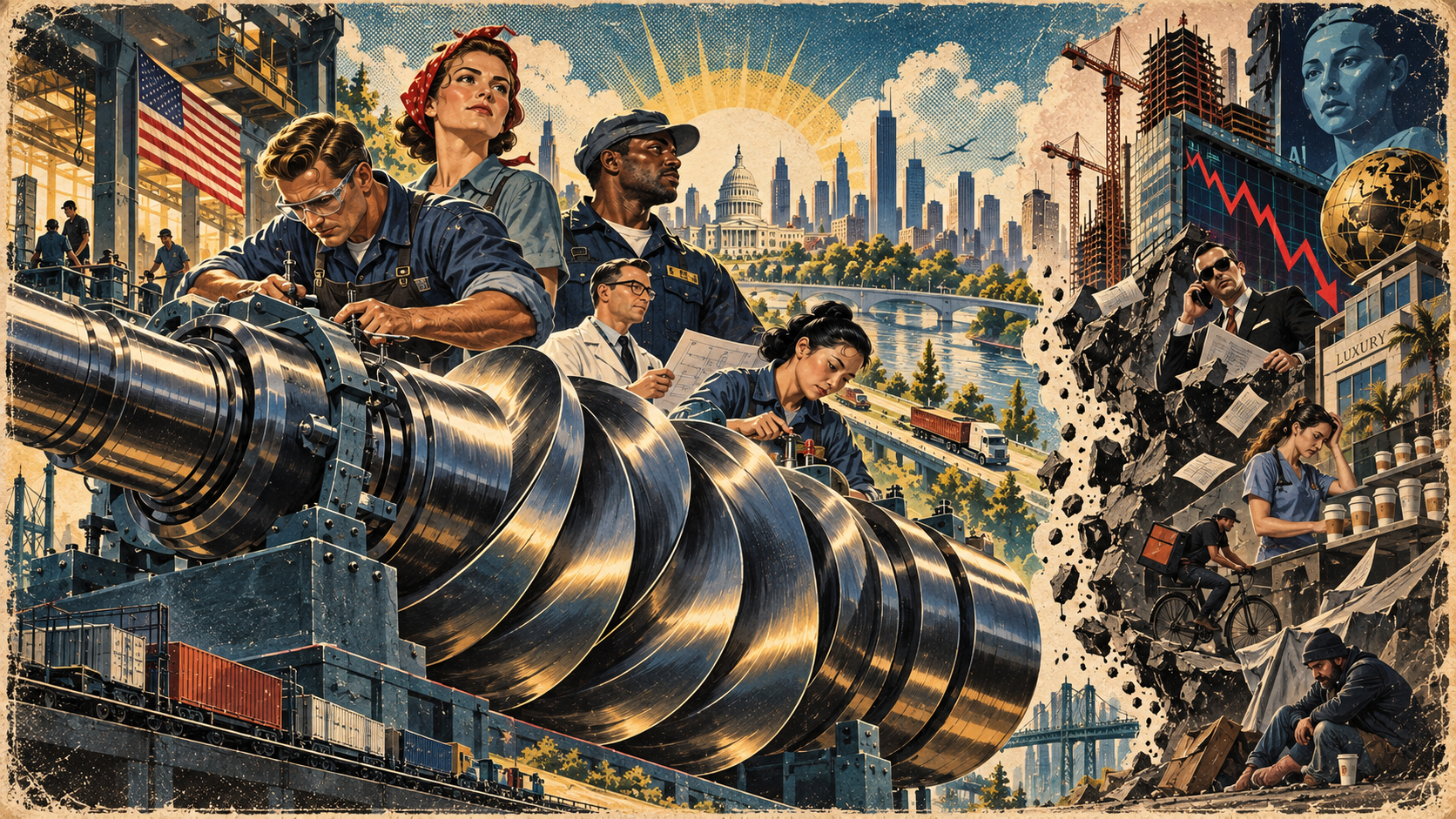
I came across a Japanese YouTube about screw compressors.
The commenter had worked for a company that manufactured them. The unusual part was the rotor machining. The tooth profile required such specialized techniques that the machining area was physically enclosed inside the factory. Even other employees were generally not allowed to see it, partly to prevent visitors from learning how it was done.
At first glance, this sounds like an obscure piece of industrial trivia.
It is actually a useful way to understand why advanced manufacturing still matters to wealthy countries—and perhaps why it matters to democracy.
A screw compressor is not technologically impressive in the way an AI model or smartphone appears impressive. Two precisely shaped rotors turn together and compress gas.
But making those rotors extremely well is difficult.
Mayekawa, one of Japan's major compressor manufacturers, describes newer rotor profiles as requiring “high-level production techniques”; improving the profile reduces internal gas leakage and increases efficiency.
Japan did not invent the modern screw compressor. Kobe Steel entered the business in 1955 through a technical alliance with Sweden's SRM and produced Japan's first domestically manufactured oil-free screw compressor the following year.
But then something important happened.
Japan kept making them.
And making them.
And making them.
Kobe eventually developed new proprietary rotor geometries, expanded the technology into refrigeration and process gases, and accumulated decades of experience in machining, metallurgy, seals, tolerances, testing and failure analysis.
That is a very different kind of technological advantage from writing a piece of software.

Some technologies take decades to become good at
A sophisticated industrial product is rarely just a blueprint.
The real capability is distributed across:
machine tools,
cutting tools,
metallurgy,
heat treatment,
metrology,
control systems,
suppliers,
production engineers,
technicians,
maintenance workers,
quality systems,
and thousands of small lessons accumulated after things go wrong.
A competitor can buy your compressor and measure it. It can obtain patents. It can hire engineers.
It still does not instantly inherit 20 or 50 years of production experience.
That matters economically because this capability is sticky.
A software founder can move from Toronto to San Francisco. Intellectual property can be transferred between corporate entities. A hedge fund can change jurisdictions. A technology company can shift headquarters surprisingly quickly.
An industrial ecosystem is harder to move.
You cannot instantaneously relocate a cluster containing machine shops, toolmakers, experienced production engineers, specialized chemical suppliers, vocational schools, testing facilities and thousands of technicians who have spent their careers solving related problems.
Germany and Japan still possess millions of workers embedded in these systems. Germany had about 7.25 million people working in manufacturing in 2025, roughly 16% of total employment. Japan had about 10.33 million manufacturing workers in 2025.
Canada, by comparison, had only 8.8% of employment in manufacturing in 2025, down from 19.1% in 1976.
That difference may matter for more than GDP.
The forgotten political virtue of advanced manufacturing
There is an old democratic bargain hidden inside an industrial economy.
Consider what it takes to operate a globally competitive machinery, automotive, electronics or chemical industry.
A country needs:
engineers,
machinists,
electricians,
technicians,
toolmakers,
production workers,
maintenance workers,
logistics workers,
supplier companies,
and managers.
Not everyone needs to attend an elite university.
But a very large fraction of the population needs to be healthy, numerate, technically competent and reliable.
That gives both firms and governments a direct economic interest in the quality of the broad population.
The feedback loop looks something like:
good mass education
→ skilled workers
→ sophisticated production
→ valuable exports
→ higher wages and tax revenue
→ better infrastructure and training
→ still more sophisticated production.
The important feature is not simply that factory workers have jobs.
It is that ordinary citizens are economically necessary to producing the national surplus.
That can create a different political economy from one in which most internationally competitive income is generated by a relatively small group of financiers, AI researchers, software founders, resource companies or owners of intellectual property.
In the latter economy, society can still be rich.
But the relationship changes.
A relatively small productive layer generates enormous surplus. The state taxes some of it. That income circulates through healthcare, construction, education, retail, restaurants and other domestic services.
The median citizen may still have a comfortable job.
But the country's ability to earn income from the rest of the world depends much less directly on that citizen's productive capability.
This does not prove that manufacturing produces democracy. It plainly does not: authoritarian states can have formidable manufacturing industries, while democratic countries can prosper with service-heavy economies.
But there is evidence that economic agency matters politically.
Research on unions finds that they historically reduced economic disparities partly by increasing the political representation of ordinary workers. The OECD's 2026 trust survey found an enormous 47-percentage-point gap in trust in national government between people who felt they had political voice and those who did not. Financial insecurity was also strongly associated with lower trust.
And research on the American “China shock” found that communities facing greater import competition suffered persistent employment and income losses, along with significant political realignment and polarization.
The relevant issue may therefore be less “factory jobs versus service jobs” than productive agency.
Why construction and healthcare are different
Construction and healthcare can provide excellent jobs.
An electrician may earn more than a machinist. A nurse may earn more than either.
Both industries are socially indispensable.
But they occupy a different place in the national economic system because they are overwhelmingly nontradable.
A Toronto electrician cannot wire an apartment in Seoul and bring foreign income back to Canada.
A nurse treating a Canadian patient usually does not create export revenue.
A Canadian machine-tool company selling equipment to Korea does.
This distinction matters because prosperous domestic services ultimately require purchasing power generated somewhere.
Construction converts income and capital into domestic assets. Healthcare converts income into health and care. Neither is automatically a source of the foreign purchasing power required to import Taiwanese semiconductors, Japanese machinery, German chemicals or Korean cars.
Construction is also unusually sensitive to credit.
Canada illustrates the scale. Residential investment supported more than 1.2 million Canadian jobs and C$152.1 billion of GDP in 2025. Canada's housing stock was worth about C$4.4 trillion, roughly one-quarter of national wealth.
Meanwhile residential mortgage debt reached approximately C$2.44 trillion by June 2026.
That does not make construction artificial. Houses are real capital.
But there is an obvious difference between:
selling a C$5 million industrial machine abroad
and
borrowing against future Canadian household income to construct a C$1 million house today.
The first earns an external claim.
The second creates a domestic asset matched partly by domestic debt.
Healthcare has a different financing problem. It is not primarily mortgage-driven, but in wealthy countries a large fraction of healthcare demand is collectively financed through taxes and social insurance. In the United States, Medicare and Medicaid alone paid for about 39% of total healthcare expenditure in 2024. Aging societies make that demand increasingly difficult to reduce.
So neither construction nor healthcare is “fake.”
The problem arises when a country increasingly relies on these sectors as substitutes for a weakening tradable productive base.
Eventually the question becomes: what generates the income that supports them?
Singapore and Saudi Arabia show another solution
Small rich economies have discovered a different way of resolving this tension: import the workers.
Singapore intentionally segments its labor market. Its current rules allow foreign Work Permit and S Pass workers to constitute as much as 83.3% of employment in construction, 60% in manufacturing and 35% in services, subject to quotas and levies.
This allows Singapore to specialize a relatively small citizen population more heavily toward finance, technology, management, engineering and other high-productivity activities while importing workers for large parts of construction and other labor-intensive sectors.
The Gulf states represent a more extreme version. The ILO describes the Arab Gulf as having the world's highest migrant-worker shares, with migrant workers heavily concentrated in construction, hospitality, domestic work and other labor-intensive activities.
Economically, this creates an adjustment mechanism.
When export income or construction demand falls, a country with a large temporary foreign workforce can reduce new permits, allow contracts to expire or slow recruitment.
The resulting labor-market adjustment does not have to remain entirely inside the citizen population.
Japan historically had much less access to this mechanism.
When Japan lost industrial pricing power during the rise of Korea, Taiwan, China and Southeast Asia, the people standing at the bottom of the labor market were overwhelmingly Japanese residents.
Japan could not export its unemployed population.
Part of the adjustment therefore appeared internally as fewer good jobs for young workers, non-regular employment, weaker wage growth, supplier pressure and eventually the large 氷河期世代 underclass Japan is still dealing with today.
Canada chose yet another model
Canada after approximately 2014 is particularly interesting.
Manufacturing continued declining as a share of employment. The commodity investment boom ended after the oil-price crash. Instead of accepting something resembling Japan's demographic contraction, Canada dramatically increased population growth.
Population growth itself created demand:
more people
→ more housing
→ more construction
→ more mortgages
→ more banking and real estate activity
→ more retail
→ more healthcare and education
→ more government services.
For a time, this was an extremely effective aggregate-growth machine.
But it did not solve Canada's underlying productivity problem.
And Canada's industrial position was already weak by German or Japanese standards.
Even before the current tariff conflict, the federal government's Canadian Occupational Projection System projected manufacturing's employment share falling from 9.0% in 2023 to 8.5% in 2033, while construction and services continued gaining employment.
The tariff conflict has made that projection look increasingly optimistic.
Canadian manufacturing output fell 2.6% in 2025, its third consecutive annual decline, while manufacturing payroll employment dropped by about 40,600 jobs during the year.
The Bank of Canada now explicitly expects tariffs to damage potential output partly by reducing investment in affected industries and reallocating workers and capital toward less productive sectors.
That is almost the textbook mechanism of gradual deindustrialization.
That would leave Canada increasingly dependent on some combination of:
resources,
technology and professional services,
finance,
foreign investment income,
construction,
healthcare,
and government-supported domestic services.
Canada can remain a rich country under such a structure.
The harder question is what happens to broad productive employment.
Immigration may become the adjustment valve
This is where I expect Canada's adjustment to become politically much more difficult than current immigration policy suggests.
The first stage has already begun.
Canada's 2026–28 immigration plan cuts new temporary-resident arrivals to 385,000 in 2026 and 370,000 thereafter, while holding permanent-resident admissions at 380,000. The government also intends to reduce temporary residents to below 5% of Canada's population.
That is the easy adjustment.
Temporary workers and students are explicitly temporary. Governments can issue fewer permits, tighten eligibility and allow existing permits to expire.
The more difficult question comes later.
What happens if, during the 2030s, Canada has a substantially larger permanent population but fewer internationally competitive jobs per resident?
Suppose manufacturing continues declining, resource industries remain extraordinarily productive but employ relatively few people, AI and finance create enormous income for a narrow professional class, and the housing sector can no longer expand through ever-rising household leverage.
At that point Canada is no longer deciding merely how many additional workers to admit.
It is deciding how to distribute a limited stock of high-productivity employment, housing, infrastructure and fiscal capacity among the population already here.
My expectation is that political pressure would then move progressively through the immigration hierarchy:
temporary workers and students first
→ fewer new permanent residents
→ much more selective permanent residence
→ eventually, pressure to reconsider the rights and obligations attached to permanent residence itself.
This last step would be politically and legally much harder.
Under current law, an expired PR card does not end permanent-resident status. Permanent residents generally lose status only through defined legal processes such as failure of the residency obligation followed by a formal determination, a removal order, voluntary renunciation or citizenship. Current law requires 730 qualifying days during each five-year period.
But permanent residence is not constitutionally identical to citizenship.
The Canadian Charter gives citizens the explicit constitutional right to enter, remain in and leave Canada. Permanent residents receive important mobility and livelihood rights, but their right to enter and remain in Canada is established by the Immigration and Refugee Protection Act and is subject to that Act.
That distinction could become politically important in a prolonged period of economic compression.
I do not expect Canada suddenly to announce that hundreds of thousands of economically unsuccessful permanent residents must leave.
A more plausible path would be incremental:
tighter physical-presence requirements,
more aggressive enforcement of residency obligations,
fewer exemptions,
greater selectivity before citizenship,
changes to eligibility or waiting periods for particular publicly funded benefits where legally permissible,
and potentially new debates about how unconditional permanent residence should be before citizenship.
Some of these measures would require legislative changes and could face serious Charter and court challenges. There is no current government proposal to carry out this program.
The prediction is instead about where the political pressure goes.
Canada's immigration system was constructed during an era when policymakers generally assumed that adding working-age residents increased Canada's productive capacity.
If the economy instead enters a period in which workers become abundant relative to internationally competitive jobs, that assumption can reverse.
Then immigration status itself becomes a labor-market buffer.
This resembles Singapore's model, but with an important difference.
Singapore intentionally maintains a large class of workers whose continued presence is conditional on employment permits. When labor demand falls, it can reduce foreign-worker quotas or simply issue fewer renewals.
Canada converted a much larger portion of its migrant population into permanent residents.
That means Canada has progressively transformed what could have been a flexible foreign-labor buffer into part of the permanent domestic population.
If economic conditions deteriorate, those people cannot simply be treated like temporary workers under current Canadian law.
That makes adjustment much harder.
But it also creates political incentives to draw a progressively sharper distinction between:
citizen
permanent resident
temporary resident.
In a rapidly expanding economy, those distinctions can become less economically important.
In a stagnant economy facing competition for good jobs, housing and public expenditure, they may become considerably more important.
That is why I expect the current restrictions on students and temporary workers to be the beginning of Canada's immigration adjustment rather than necessarily its endpoint.
If Canada's internationally productive economy continues weakening relative to its population through the 2030s, the political debate may eventually cease to be merely:
How many new immigrants should Canada admit?
and become:
What obligations does Canada owe to non-citizens already granted permanent status, and what obligations should continued permanent status impose in return?
That would mark a profound reversal from the political economy of Canada between roughly 2015 and 2024.
The thing that cannot be recreated quickly
This brings us back to the screw compressor.
The attraction of advanced manufacturing is not nostalgia for factories.
Low-value assembly is not inherently desirable. A wealthy country should not try to preserve every factory job merely because it involves physically making something.
The strategically interesting industries are the ones in which decades of accumulated knowledge allow ordinary skilled workers to participate in production valuable enough to support rich-country wages.
A screw-compressor rotor.
A precision reducer.
A semiconductor-production subsystem.
An aircraft engine component.
An industrial robot.
A specialized chemical.
A high-end machine tool.
These industries produce something unusual:
high productivity + international tradability + broad occupational participation + geographically sticky accumulated knowledge.
AI and finance can produce extraordinary wealth, but their direct employment bases are relatively narrow and their highest-value people and capital are unusually mobile.
Construction and healthcare can employ millions, but their prosperity ultimately depends heavily on income and fiscal capacity generated elsewhere.
Resources can produce enormous export rents, but require surprisingly few workers.
Advanced manufacturing is one of the few economic systems capable of putting a large middle of society directly inside internationally competitive production.
That may turn out to matter politically as much as economically.
The strongest version of the argument is not:
Factories create democracy.
They don't.
It is:
A democracy may be more stable when national prosperity depends on the competence, skills and productivity of a broad part of its own population.
If millions of ordinary citizens are necessary to produce what the rest of the world wants, then educating them, training them, keeping infrastructure functional and allowing them to participate in rising productivity is not merely social policy.
It is economic necessity.
The alternative can still be prosperous.
A narrow layer of AI, finance, resource and intellectual-property winners can generate enormous wealth. That wealth can support millions of people working in healthcare, construction and local services.
Singapore and the Gulf demonstrate versions of this model at small scale, supplemented by large imported workforces.
But for countries with tens or hundreds of millions of permanent citizens, the political economy is different.
The question eventually becomes not merely:
How rich is the country?
but:
How many of its citizens are genuinely necessary to producing that wealth?
Germany, Japan, Korea and Taiwan still have unusually strong answers to that question.
Canada increasingly does not.
And if China's industrial rise begins compressing the remaining rents of Japan and Germany as well, the coming decades may provide one of the largest tests yet of whether rich democracies can preserve broad economic agency after the industrial system that historically produced it begins to shrink.