
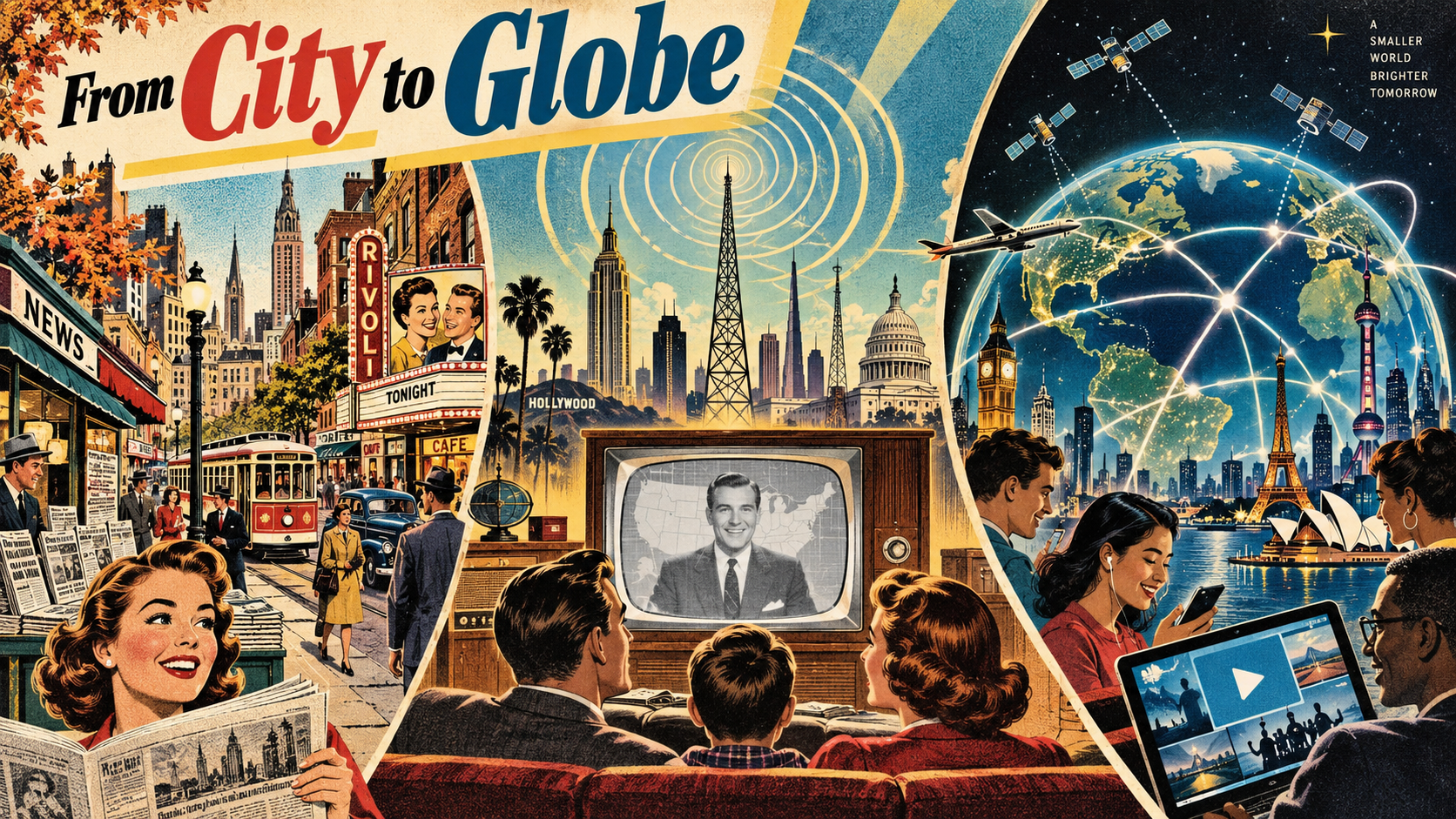
When we talk about new media, we usually ask the wrong question.
Will television kill newspapers?
Will the internet kill television?
Will AI kill Hollywood?
History suggests that institutions rarely disappear so neatly. Newspapers survived radio. Radio survived television. Universities survived mass culture. Television survived the internet.
The more important change happens somewhere else:
the geographic scale at which power is organized changes.
A medium can survive while losing the functions that once made it central.
That is what happened to American cities during the rise of national radio and television. And it may be happening to countries today as digital media becomes genuinely global.
The interesting historical sequence may be:
city → nation → globe
with each expansion producing a new round of consolidation.
Before national media, cities were much more complete worlds
It is difficult today to appreciate how culturally autonomous major cities once were.
St. Louis was culturally St. Louis.
Milwaukee was culturally Milwaukee.
Boston, Chicago, Philadelphia and New Orleans each had stronger independent information environments than their equivalents do today.
This was not simply a matter of regional accents or cuisine.
The differences had an economic infrastructure behind them.
A large city could support multiple competing newspapers, publishers, theaters, advertisers, political factions, department stores, local business elites and intellectual circles.
The newspaper was especially important because its economics were local.
A serious newspaper required expensive presses, reporters, editors, paper, distribution networks and enough advertisers and readers to pay for all of it.
That meant the natural market was usually a city or region.
By 1923, more than 500 American cities still had competing daily newspapers.
That is a remarkably decentralized information system compared with the America that emerged later.
A resident of St. Louis did not merely receive a slightly different version of the same national feed.
St. Louis had institutions whose job was to decide what St. Louis should know.
The telegraph globalized information before it globalized audiences
This makes the telegraph era especially interesting.
By the second half of the nineteenth century, information could already travel across continents almost instantaneously.
London bankers could communicate with New York.
Governments could communicate with embassies.
Reuters and other news agencies could move information through international cable systems.
In that sense, a global information network existed more than a century before the Web.
But it was a thin network.
The architecture looked roughly like:
global telegraph network → local newspaper/institution → local population
The telegraph moved information between elite nodes.
It did not directly deliver a rich stream of information into every household.
So the nineteenth century could simultaneously have:
global finance and diplomatic communication
while maintaining
highly local public cultures.
The global layer provided wholesale information.
Cities still controlled retail distribution.
Radio and television changed the geographic unit
Radio broke this architecture.
For the first time, a performance or message produced in one city could reach millions of ordinary people simultaneously.
A performer no longer needed to travel from city to city.
A national broadcaster could distribute the same program everywhere.
Television intensified this by adding images.
The economics changed dramatically.
Suppose St. Louis can spend $20,000 producing a local show for 500,000 viewers.
A national network can spend $1 million producing something for 40 million viewers.
The national production can be vastly more expensive and polished while still costing less per viewer.
At that point, local cultural preference has to be very strong to justify duplicating the expensive production infrastructure in every city.
The result was not that local institutions instantly disappeared.
Instead, they became nodes inside a national system.
A Cleveland television station still existed.
It still sold local advertising.
It still produced local news.
But much of the expensive programming came from New York or Los Angeles.
The local institution survived while losing upstream functions.
That distinction matters.
By around 1960, the winners were largely visible
The most intense geographic consolidation happened roughly between the 1920s and 1960s.
New York captured national advertising, publishing, network headquarters, finance and much of national news.
Los Angeles captured filmed entertainment.
Washington captured political information as the federal government itself became more important.
Chicago remained enormous.
St. Louis remained a real city.
Boston remained prestigious.
But the question of which cities controlled the national information system was increasingly settled.
That is why I would divide the twentieth-century media era into two phases.
1920–1960: consolidation
The geographic unit expands from city/region to nation.
Local competition declines.
National networks form.
Advertising becomes national.
Corporations operate nationally.
People move across the country in much greater numbers.
A handful of cities capture disproportionate command functions.
1960–2000: maturity
The national system deepens rather than fundamentally changing geographic scale.
CBS, NBC and ABC dominate television for decades.
Hollywood becomes structurally entrenched.
New York remains the center of advertising, publishing and finance.
Washington remains the political information capital.
Cable later fragments the audience, but mostly within the same American national market.
This is why 2000 makes more sense to me as the endpoint of the national mass-media regime than 1980.
In 1980, America was still overwhelmingly consuming media through nationally organized institutions.
Around 2000, the distribution architecture itself started escaping the nation.
The developing-world megacity boom belongs to the same national era
This also changes how we should understand the rise of cities such as:
São Paulo
Mexico City
Istanbul
Delhi
Jakarta
Lagos.
Their twentieth-century rise was not simply “cities getting big.”
It was fundamentally part of national development.
The sequence looked something like:
rural population
→ industrialization
→ migration into the dominant national city
→ national corporations
→ national advertising
→ national television
→ national capital and talent concentration.
São Paulo became extraordinarily powerful because Brazil was becoming an integrated national economic system.
Mexico City benefited from the same process in Mexico.
Jakarta concentrated Indonesian economic functions.
Delhi and Mumbai accumulated Indian functions.
This was the developing world's version of the same geographic transition the United States had undergone earlier.
But that creates an important possibility.
Their rise may belong to the national-media equilibrium, not necessarily the global one that follows it.
A city can keep gaining population while losing relative command importance.
Jakarta could add millions of people while its best founders, financiers, scientists and producers increasingly operate through global hubs.
Population and command power are not the same variable.
Population growth creates cities. Integration chooses command cities.
Tokyo demonstrates another side of this.
Japan is shrinking and aging.
Yet Tokyo can continue attracting people from the rest of Japan.
That means an aging society does not necessarily produce immediate decline in its dominant city.
It can produce stronger concentration.
A shrinking country can still have a growing apex because that apex is consuming talent and population from everywhere underneath it.
The same mechanism can operate globally.
The next stage does not require hundreds of millions of people to relocate internationally.
It may only require the most valuable tail of the distribution to move.
If the best fraction of:
founders
scientists
financiers
artists
engineers
executives
producers
can participate in one international labor and capital market, relatively small migration flows can produce enormous concentration of command power.
Jakarta can gain ten million ordinary residents while losing 50,000 unusually globally mobile people.
For many high-value industries, the second number may matter more.
The internet may be doing to nations what television did to cities
This gives us a useful historical periodization:
| Period | Dominant geography | Structure |
|---|---|---|
| ~1850–1920 | global command + local publics | Telegraph connects elite institutions globally, while newspapers organize city life |
| ~1920–1960 | national consolidation | Radio/TV, national advertising and mobility hollow out independent city systems |
| ~1960–2000 | mature national regime | A few command cities and networks dominate relatively stable national systems |
| ~2000–2040? | global consolidation | Digital distribution begins hollowing out independent national systems |
| ~2040–2080? | mature global regime | Potentially a small number of global command nodes with national/local layers beneath them |
The dates are obviously approximate.
History does not obey eighty-year cycles.
But the structure is worth taking seriously.
Around 2000, something qualitatively changed:
distribution stopped naturally ending at the national border.
The internet was initially weak compared with television.
Then broadband, smartphones, social media, streaming and global platforms accumulated.
Now AI translation attacks language barriers.
Digital payments attack monetary friction.
Remote work attacks labor-market geography.
Future faster aviation may attack physical distance among globally mobile elites.
Each one makes national duplication harder to justify.
Cultural difference may not protect national systems as much as we assume
This is where historical analogies become uncomfortable.
People often assume French media will remain French because France is culturally distinctive.
Japanese media will remain Japanese because Japan is culturally distinctive.
Canadian media will remain Canadian because Canada is different from the United States.
But St. Louis was distinctive.
Texas was distinctive.
New England was distinctive.
Milwaukee's German-American culture was extremely distinctive.
Those identities survived national consolidation.
What disappeared was the economic requirement that each place maintain a complete independent hierarchy of cultural production and command.
Texas could remain Texan while consuming nationally produced television.
Boston could remain Boston while New York dominated national publishing and advertising.
Cultural identity survived underneath the larger system.
So the proper question is not:
Is France different from America?
It obviously is.
The question is:
Is France different enough that it economically requires an entirely separate full-stack media, technology, financing and talent system?
Those are very different claims.
The next consolidation could be much harsher than today's global-city lists suggest
If the analogy holds, today's debate over London, Paris, Singapore, Toronto, São Paulo, Mumbai or Amsterdam may eventually look like debates over which American regional city would dominate the twentieth century.
Many of them can remain:
rich
large
beautiful
culturally important
regionally dominant.
That does not make them apex command centers.
Chicago remained one of America's great cities.
It simply stopped competing with New York for certain national command functions.
London could eventually occupy a similar position in a fully integrated Atlantic economy: immensely prestigious and important, but increasingly downstream from the principal global command node.
The same could happen to much of Europe.
Its many important cities partly reflect centuries in which separate countries needed separate capital, banking, media and professional systems.
If those national systems become layers inside a global system, many of those duplicated command functions become economically redundant.
New York may therefore be stronger than raw population forecasts suggest
The safest mistake would be to assume the places leading today's newest industry will necessarily become the final winners.
That would have made Detroit look unbeatable during the rise of automobiles.
It would have made Chicago look structurally dominant during industrial America's rise.
San Francisco may be the world's dominant technology cluster today.
That does not guarantee it becomes the dominant city of the mature global digital regime.
Technology itself may eventually commoditize some of the scarce engineering and startup capabilities that currently sustain the Bay Area's advantage.
New York's specialization is more abstract.
It specializes in:
coordination.
Capital allocation.
Corporate control.
Finance.
Law.
Media.
Advertising.
Deals.
Status.
International talent.
Those functions become more—not less—valuable when many national systems are integrated into one larger market.
And if talented Europeans, Canadians, Indians and others increasingly enter a common English-speaking global elite labor market, New York's talent pool is no longer primarily American.
Europe can feed New York in the same way America's regions once fed New York.
That produces the familiar agglomeration loop:
talent moves to the strongest network
→ the network gets stronger
→ capital follows
→ firms follow capital
→ more talent moves.
China is the major exception because it built a wall
This framework also explains why China is different.
China's potential to maintain a separate command system does not come simply from having 1.4 billion people.
India also has roughly that scale.
The crucial difference is that China has deliberately prevented its information economy from being completely absorbed into the American-led digital system.
It maintains:
domestic platforms
capital controls
media censorship
political barriers
technology policy
military independence.
China therefore possesses a real structural barrier to consolidation.
India mostly does not.
An Indian founder can operate in English.
An Indian creator can use American platforms.
An Indian financier can participate in New York markets.
India becoming richer may therefore strengthen American/global command hubs rather than automatically producing an independent Indian apex.
Large population alone is insufficient.
There has to be some mechanism preventing absorption.
The really strange historical possibility
The most interesting implication is that the twentieth-century nation-centered media system may itself have been temporary.
For a few generations it seemed natural that every important country should possess:
national newspapers
national television networks
national movie stars
national advertising agencies
national entertainment industries
national business elites.
But perhaps this was simply the equilibrium created by radio and television.
Before it, major cities supported more independent information systems.
After it, global digital networks may support fewer independent national systems.
Seen this way, the twentieth century becomes one stage in a much longer geographic expansion:
religious/civilizational networks — enormous reach, extremely low bandwidth
printing — much richer information, more regional/national fragmentation
newspapers — highly detailed city publics
telegraph — global command communication returns, but mass audiences remain local
radio/television — rich mass communication expands to national scale
internet/digital — rich, instantaneous, personalized communication expands toward global scale.
The historically unusual thing about digital technology is not simply that it reaches the world.
Religions and telegraph networks already reached enormous territories.
Digital media combines:
global reach + audiovisual bandwidth + instantaneous updates + personalization + measurement + two-way participation.
Earlier systems usually had to trade geographic reach against informational resolution.
Digital systems increasingly do not.
We may currently be closer to 1935 than 1975
That is perhaps the most useful way to think about the present.
By 1960, the winners of America's national-media consolidation were already relatively obvious.
The next forty years largely deepened the system those winners controlled.
If 2000 marks the beginning of a comparable global transition, then today we are only about twenty-five years into it.
We should not necessarily expect the geographic hierarchy to be settled yet.
Today's prominent cities may be equivalent to the strong American regional centers that still looked formidable during the early years of national consolidation.
The interesting period may be roughly 2000–2040 or 2050, when the sorting happens.
After that, a mature global regime could become surprisingly stable.
The eventual result might not be hundreds of equivalent national media capitals.
It could be a tiny number of genuine global command nodes, with large national and regional cities operating beneath them.
The important lesson from the last transition is that the losers do not need to disappear.
St. Louis still exists.
Chicago still matters.
Boston is still prestigious.
Their cultures survived.
What changed was the hierarchy.
And that may be exactly what is beginning to happen to countries today.
Population growth creates cities.
Integration chooses command cities.
And every expansion in the geographic scale of media forces the hierarchy to be chosen again.