
From inside elite circles in the 1990s, Japan was already considered “finished.”
The asset bubble had burst. GDP stagnated. Demographics turned negative.
In high-culture and academic environments—from Paris to Boston—the consensus was simple: Japan peaked in 1989.
And yet, between 1990 and 2020, Japan won one of the most decisive soft-power victories of the modern era.
- Not through diplomacy.
- Not through ideology.
- Not even intentionally.
But through anime, manga, and games.
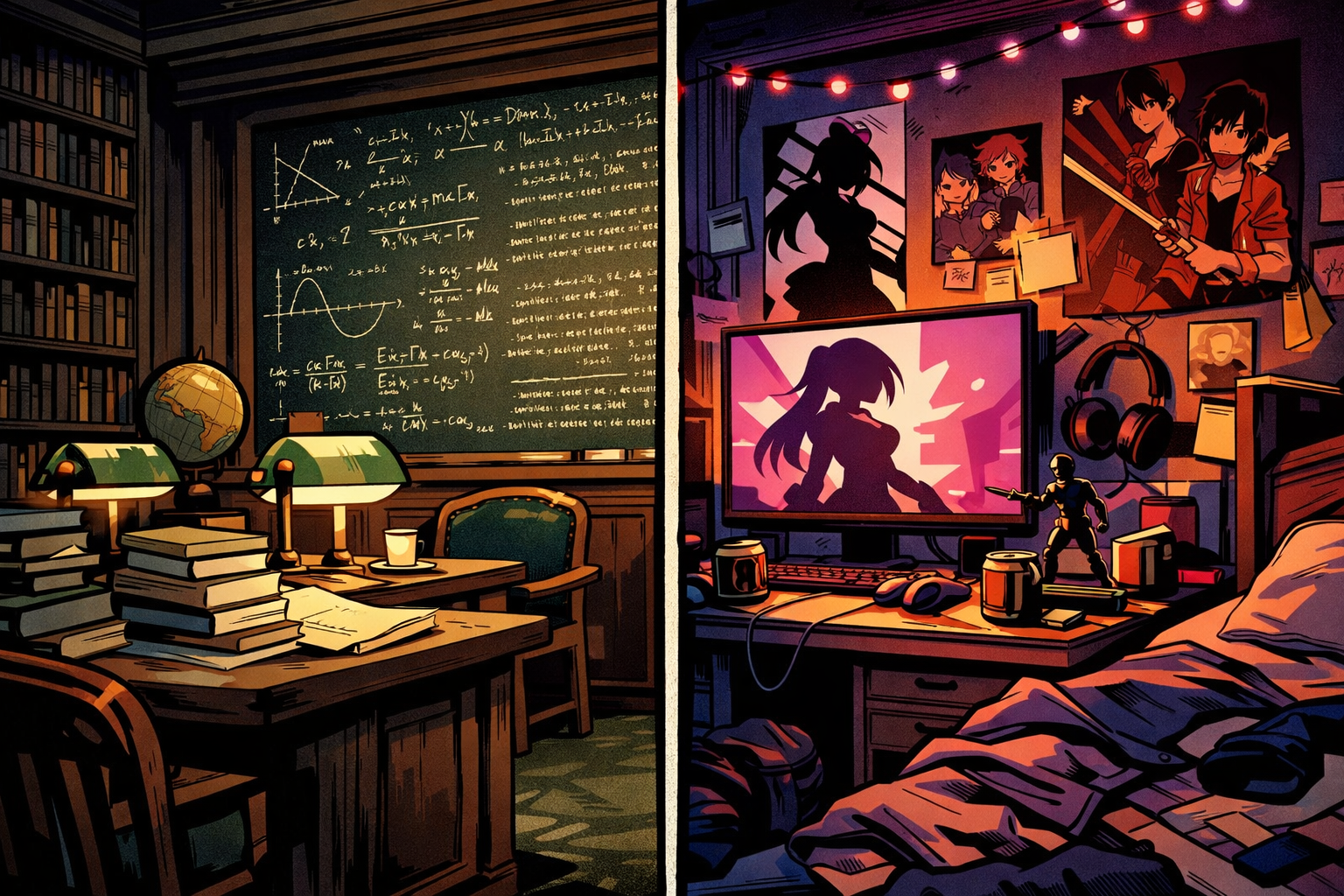
What unfolded over those three decades was not a culture clash in the traditional sense. It was a competition between two incompatible models of soft power:
Top-down moral authority, exported by elite American institutions
Bottom-up aesthetic desire, exported accidentally by Japan
This was not Hollywood vs. Tokyo.
It was Boston vs. Akihabara.
Two Soft-Power Operating Systems
By 1990, the United States had absorbed the legacy of French high culture and upgraded it.
Where Paris once dominated salons, Boston (Harvard, Yale, MIT) now dominated credentialed morality.
Boston-Led Feminism (Institutional Soft Power)
Origin: Elite universities, NGOs, media, HR departments
- Transmission: Education systems, grants, journals, prestige media
- Core mechanism: Norm enforcement
- Language: Abstract, moralized, dense (hegemony, performativity, intersectionality)
This was soft power by gatekeeping.
To participate, you had to learn the language, signal compliance, and internalize the framework.
It resembled French aristocratic culture in the 18th century:
If you don’t speak it fluently, you are not elite.
Japanese Anime (Subcultural Soft Power)
Origin: Commercial studios, hobbyists, fan communities
- Transmission: VHS → fansubs → internet → streaming
- Core mechanism: Desire
- Language: Visual, intuitive, universal
Anime did not demand agreement.
It did not moralize.
It did not ask permission.
It simply offered worlds where:
- Competence mattered
- Power existed
- Effort led somewhere
- Heroism was allowed
Japan exported fiction, not ideology.
And fiction travels faster.
The Blind Spot of the 1990s Elite
This is the key historical mistake.
American elites noticed feminism’s institutional spread.
They did not notice anime’s psychological penetration.
Because anime didn’t show up in:
- Foreign policy memos
- Academic citations
- NGO funding flows
- Opinion pages
It showed up in:
- Bedrooms
- After-school TV
- Torrent sites
- Teen imaginations
To elites, anime was “just cartoons.”
To a generation, it was formative.
By the time the elite realized what had happened, the preferences were already locked in.
2010–2020: When the War Went Hot
The conflict became visible only when American institutional culture tried to discipline entertainment itself.
This is when the collision happened.
Hollywood began moralizing narratives
Western comics deconstructed heroes
Video games were reframed as social education tools
At the same time:
Manga doubled down on classic archetypes
Anime ignored Western criticism entirely
Japanese studios optimized for fans, not approval
The response from Japan was not resistance.
It was indifference.
And indifference is devastating to moral authority.
The Market Rendered Its Verdict
By 2020, the results were undeniable:
- Manga outsold American comics globally
- Anime films outperformed Hollywood franchises
- Western youth recognized Goku more than Superman
Japan won not because it argued better — but because it never argued at all.
American soft power increasingly came bundled with instruction.
Japanese soft power came bundled with pleasure.
Humans choose pleasure.
The Irony: Japan Won While Being Declared “Dead”
This is the part high-culture circles still struggle to accept.
Japan “lost” in:
- GDP growth
- Population
- Financial headlines
But it dominated where it mattered most long-term: taste formation.
The elite believed power flowed from institutions downward.
Japan proved that culture flows upward from desire.
By the time Boston noticed China in journals and citation indexes,
Japan had already reshaped the emotional architecture of a generation.
Final Insight
From 1990 to 2020, the real soft-power war was not America vs. China.
It was:
Institutional morality vs. aesthetic freedom
Boston built a system of norms.
Japan built worlds people wanted to live in.
Only one of those scales globally without enforcement.
And that is why Japan, declared “dead” since 1990, quietly won the most human form of power there is: what people want when no one is watching.