economics France Lost Its Empires. Paris Kept Its Power. Territorial empires disappeared. Paris remained. That may be the more important fact.In my last piece, After the Frontier, I looked at what tends to happen once an expansionary civilization
Artificial Intelligence The AI Barbell: The Most Vulnerable Countries of 2050 Will Be the Normal Ones Cheap AI, solar power, drones, and private networks may create resilient low-state societies—while ordinary modern countries become the most vulnerable places on EarthThe most vulnerable country in 2050 may
International Relation Your Country Is Your Largest Undiversified Portfolio A rough historical model suggests that the chance of a catastrophic domestic conflict over the next 50 years may be closer to 50% than 5%. If that order of magnitude
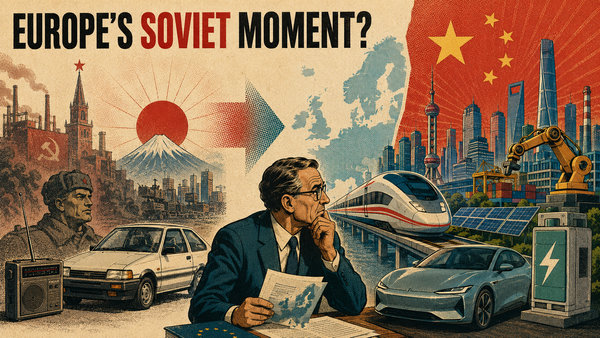
International Relation Europe’s Soviet Moment May Arrive in the 2030s Japan did not defeat the Soviet Union. It helped convince Soviet elites and citizens that their economic model had failed. China may be doing something similar to Europe.The most
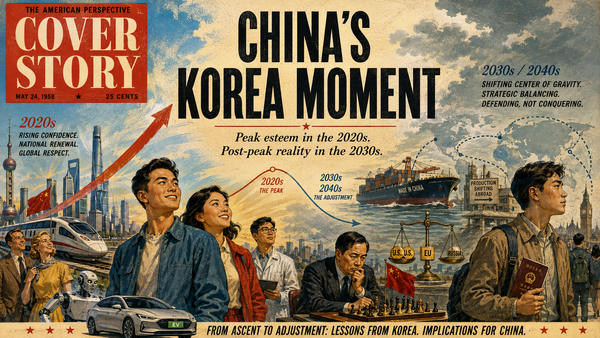
International Relation China’s 2020s May Be What Korea’s 2010s Were: The Decade Before the Mood Turns Why China’s 2020s may resemble Korea’s 2010s—and why the 2030s could feel very different There is a particular national mood that appears near the end of a
International Relation After America Wins: From Creative Destruction to Corporate Nationalism The end of the China shock could produce an American capitalism almost opposite to the one we have known since 1980For most of the last forty years, American capitalism has
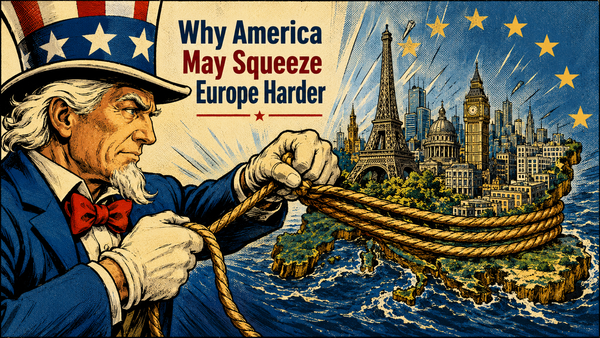
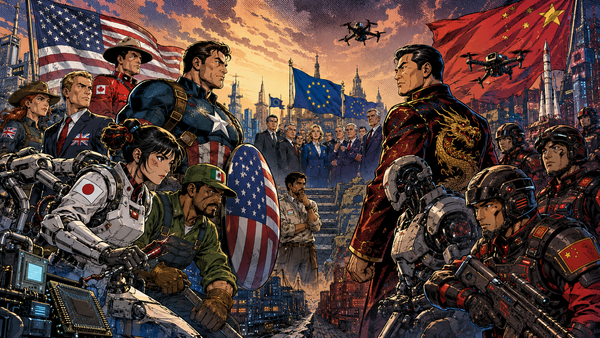
International Relation Why America Cannot Let Europe Go, and May Squeeze It Harder The China shock may not shrink the American empire. It may force America to integrate a much larger one.A few days ago, I thought the emerging American strategy was
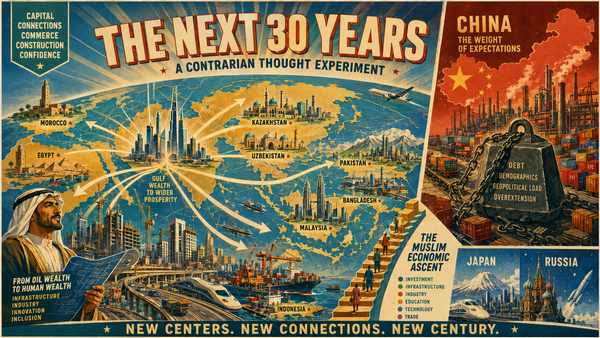
International Relation The Next 30 Years May Belong to the Countries We’ve Written Off A thought experiment about China’s burden, a richer Muslim world, and why the 2060 map may look nothing like today’s consensusHere is a thought experiment. Not a prediction.
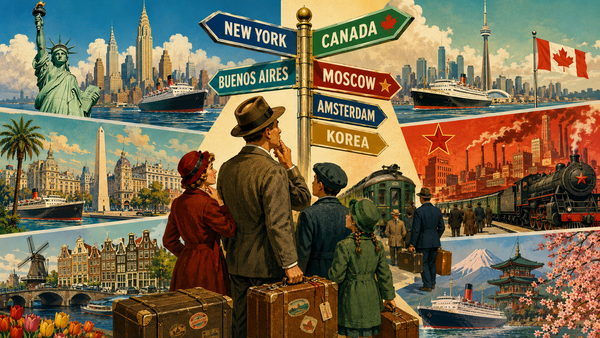
economics Why So Many Migrants Chose the Wrong Country in the 20th Century—and How to Choose Better Today If you had to choose where your family would live for the next 30 years, what could you actually know in advance?One of the strangest things about looking back
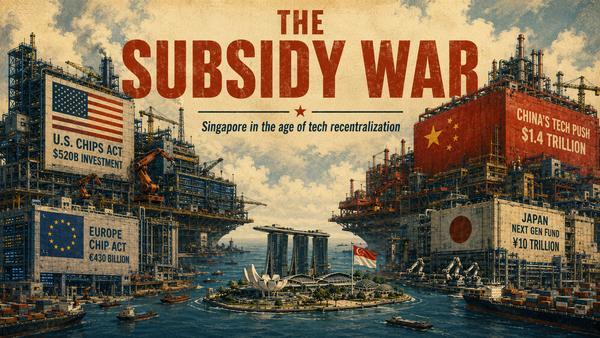
Future Singapore Won the Tax War. It May Lose the Subsidy War. For most of the last fifty years, Singapore looked like the country that had solved economic development. It did not have America's domestic market. It did not have China's population.
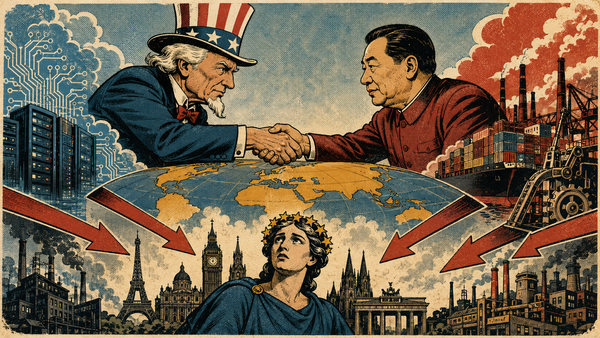
International Relation The Deal Above Europe’s Head Why the biggest threat to European sovereignty may not be U.S.–China conflict, but a U.S.–China settlementI think there is a geopolitical possibility that is still maybe
International Relation Why the Tokyo University Is Becoming a Rational Alternative to the Anglosphere for Chinese Elites I started thinking about this after watching a Japanese YouTube video, 「日本人が知らない、東大院生の2割が中国人の理由」. Its starting point is simple: Why are so many Chinese students now studying at the University of
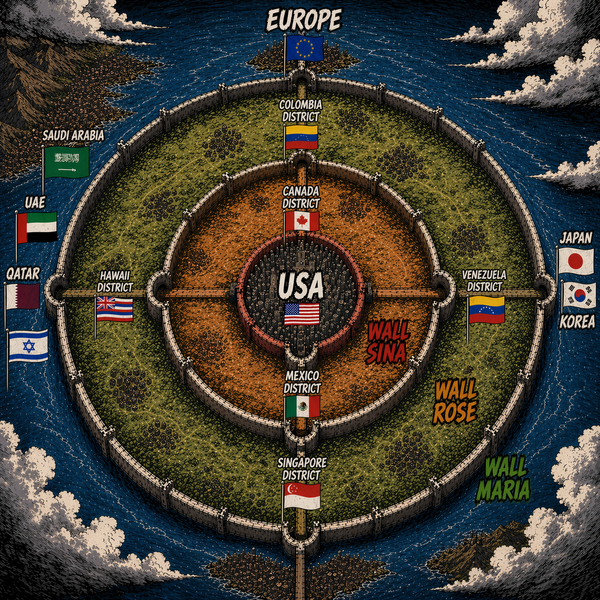
economics What If America Isn’t Retreating From the World—But Building a Smaller Empire It Can Actually Control? For the last fifteen years, almost every major geopolitical narrative has pointed in the same direction: American decline. Obama said America could no longer behave like the world’s policeman.
International Relation Attack on Titan Was Never About Titans. USA Retreat Analogy Most people watched Attack on Titan and saw monsters. The sharper read is military history. It is a story about a ruling order that decides the world is too expensive
Future How China Learned From Neighbors' Failures—and What Comes After 2030 China’s V3.0 Operating SystemThere is a persistent Western myth that China’s rise was either accidental, purely opportunistic, or a crude copy‑paste of capitalism with Chinese characteristics
economics The New Elites Don’t Fight the Working Class They Use Them — Then Replace Them Most people misunderstand modern geopolitical conflict because they still think in left vs right or capital vs labor. That frame is obsolete. The real
International Relation 1990–2020: The Quiet Soft Power War Between Boston Feminism and Japanese Anime From inside elite circles in the 1990s, Japan was already considered “finished.” The asset bubble had burst. GDP stagnated. Demographics turned negative. In high-culture and academic environments—from Paris to
economics 2026–2045: The Great Rebalance — A Forecast of US Collapse Timeline, Autarky, and a New World Order Today’s date: 2026. If you look at the data — weakening dollar confidence, political pressure on monetary policy, and rising tariffs — we aren’t on the brink of a cyclical
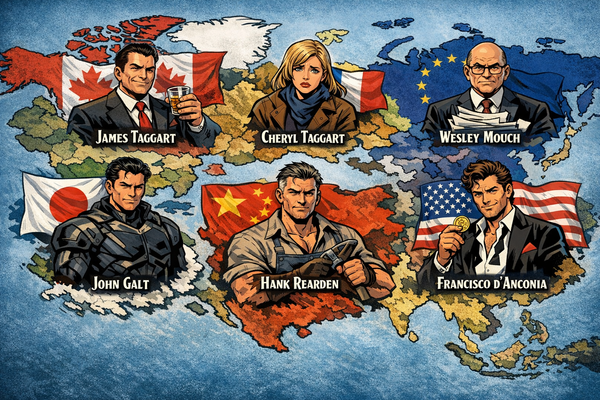
International Relation The Geopolitics of Atlas Shrugged: A 2026 Map e often analyze geopolitics through the lens of Realism (military power) or Liberalism (institutions). But as the global order fractures in 2026, those frameworks are failing. They measure capacity, not
International Relation When US Politics Turn on the Press: How NHK Quietly Became the Last Stable Public Broadcaster Standing In 2025, three of the world’s biggest public broadcasters — the BBC, Germany’s ARD, and France Télévisions — are under fire from their own political classes. Across continents, populist and
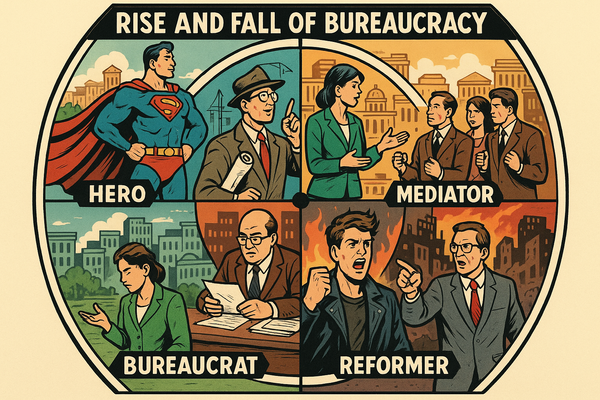
Future The Psychology of Bureaucratic Collapse: How Big-5 Personality Shapes the Fate of Nations Every empire, company, and ministry eventually drowns in its own paperwork. But beneath the forms and regulations lies something older — the psychology of the people who build, maintain, and finally
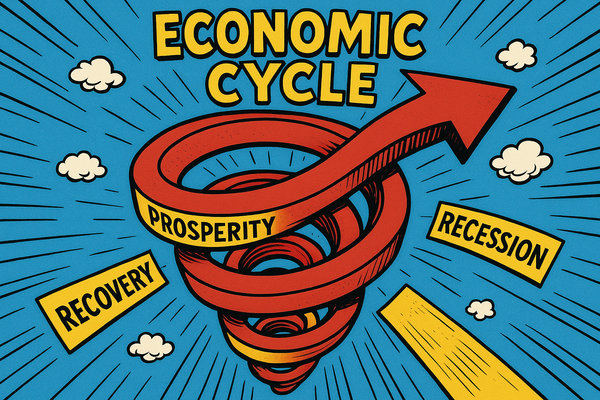
economics Civilizational Mechanics: How Nations Rise, Peak, and Recycle Power Every civilization climbs the same invisible curve — discovery, consolidation, decadence, and reinvention. The 21st century is no exception: the U.S. resists decline, Japan quietly monetizes maturity, and emerging powers
economics The Sovereign Flip: Why 2020–2060 Will Mirror 1880–1920 Marxism Wave in Reverse In 1848, Karl Marx published The Communist Manifesto, diagnosing the birth pains of industrial capitalism. Das Kapital was publsihied in 1868. In 1997, James Dale Davidson and William Rees-Mogg published
economics From Sterling Bloc to Dollar Bloc: Could the U.S. Extend Reserve Dominance by Squeezing Europe’s Periphery? In the interwar years, Britain was already losing ground. The U.S. dollar had emerged as the new safe asset during World War I, and by the 1930s London’s
Future Why Japan’s ‘Strategic Shrinkage’ Could Rewrite Growth Models Built Since Britain’s Industrial Revolution When Britain began laying railway lines in the early 1800s, it had no precedent to follow. There were no return-on-investment (ROI) models for building a coal factory, a railway tunnel,