
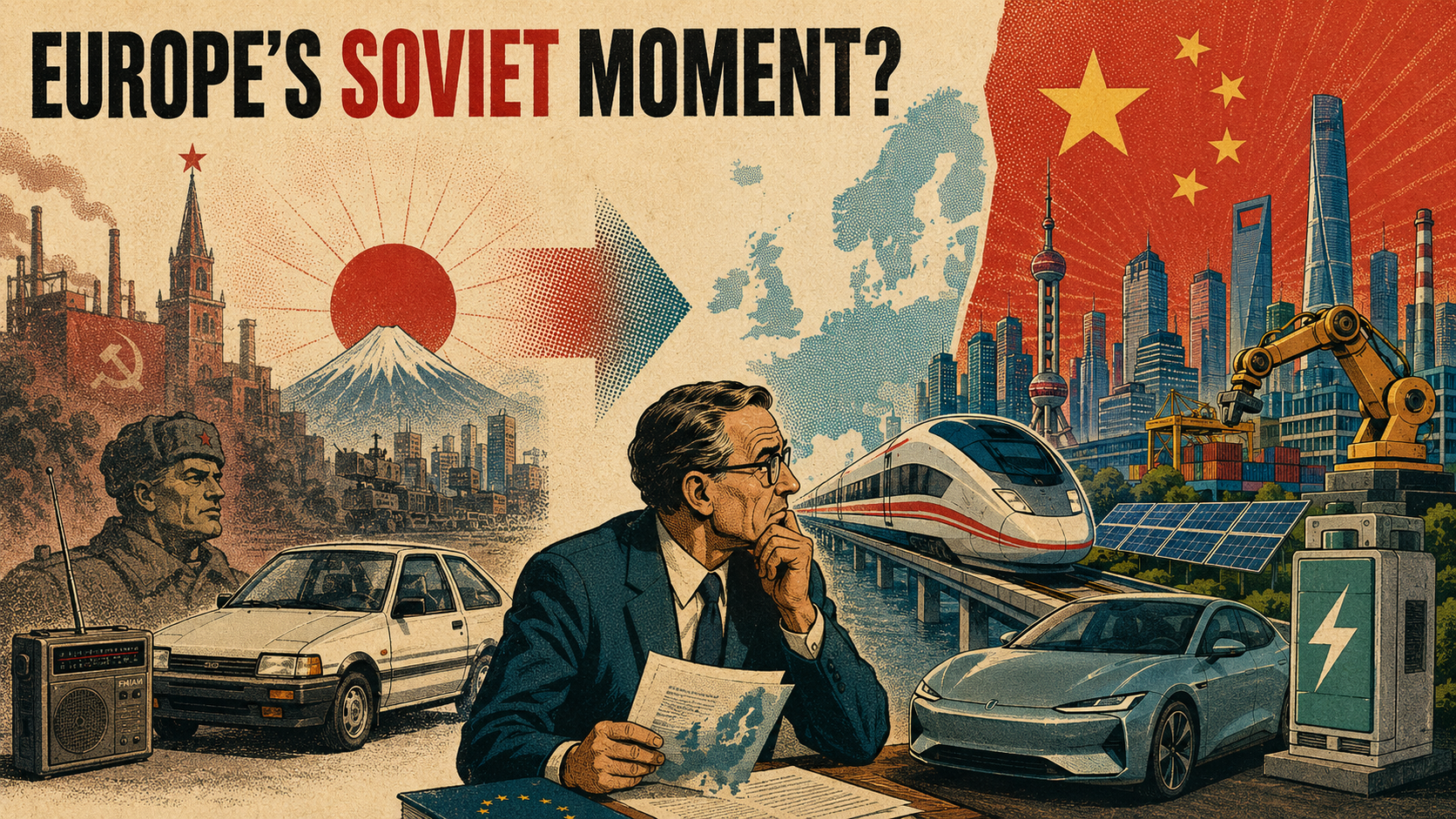
Japan did not defeat the Soviet Union. It helped convince Soviet elites and citizens that their economic model had failed. China may be doing something similar to Europe.
The most consequential thing Japan did to the Soviet Union in the 1980s was not military.
Japan did not threaten Moscow. It did not win an arms race against the USSR. It did not force the Soviet Union out of Eastern Europe.
What Japan did was more psychologically destructive:
it made the Soviet model look obsolete.
By the 1970s, Soviet leaders could still describe their country as one of the world's great modern industrial civilizations. The USSR possessed nuclear weapons, spacecraft, advanced aircraft, enormous steel and machinery industries, world-class mathematics and physics, and one of the two superpower militaries.
Its economic failures could still be rationalized.
The United States was richer, but Soviet citizens were told that America achieved its wealth through capitalism, inequality, unemployment, consumerism and exploitation.
The USSR was supposedly pursuing different goals.
Then Japan became impossible to ignore.
Here was a country that had been physically devastated in 1945, possessed few natural resources, maintained a relatively small military, and had a fraction of Soviet territory.
Yet by the 1980s Japan was producing some of the world's best:
- automobiles;
- semiconductors;
- consumer electronics;
- industrial robots;
- machine tools;
- ships;
- cameras;
- precision components;
- public infrastructure.
Japan became the world's largest automobile producer around 1980. By the late 1980s Japanese firms controlled roughly half of the global semiconductor market. Japanese nominal GDP rose from roughly $1.1 trillion in 1980 to more than $3 trillion by 1990.
The comparison became politically poisonous because Japan did not merely outperform the USSR.
Japan invalidated the Soviet explanation for why the USSR underperformed.
If the Soviet model really represented industrial modernity, why could Japan build better cars?
Why did Japan have better electronics?
Why were its factories more productive?
Why were its trains better?
Why were ordinary Japanese households surrounded by technologies Soviet engineers could not provide their own population?
Eventually the comparison stopped being:
Japan is doing unusually well.
It became:
Something is fundamentally wrong with us.
That shift mattered.
Once Soviet citizens and policymakers began believing the problem was not an isolated policy mistake but the system itself, reform became destabilizing rather than restorative.
Gorbachev did not create Soviet economic doubt. He inherited it.
And when the political system finally cracked, Soviet economic prestige did not merely decline gradually.
It collapsed.
Russia inherited nuclear weapons, aerospace expertise, world-class scientists, enormous energy reserves, sophisticated military industries and a permanent UN Security Council seat.
But economically, the old status was gone.
Nobody in 2000 thought:
United States, Japan, Germany, Russia — four roughly equivalent centers of advanced economic power.
Russia had retained extraordinary capabilities.
It had lost the presumption of systemic competence.
That loss proved remarkably permanent.
China may be playing the same role for Europe
This is the analogy I think matters for the 2020s.
The conventional way to describe China's rise relative to Europe is quantitative:
China's economy is getting larger.
China manufactures more.
China exports more goods.
But that misses the stage we are now entering.
China already won the quantitative manufacturing contest years ago.
By 2024, China accounted for about 32% of global manufacturing value added.
The United States was around 15%.
Japan roughly 6%.
Germany around 5%.
South Korea around 3%.
China alone therefore produced more manufacturing value added than the United States, Japan, Germany and South Korea combined.
That is not the important new development of the 2020s.
Europe had already learned to live psychologically with Chinese scale.
The comforting explanation was straightforward:
China has quantity. Europe has quality.
China had factories.
Europe had engineering.
China had cheap labor.
Europe had technology.
China assembled.
Europe designed.
China competed on cost.
Europe competed on sophistication.
That story allowed Europe to preserve its status even after the quantitative balance had shifted decisively toward China.
The dangerous development of the 2020s is that China is beginning to remove the qualitative escape hatch as well.
The sequence looks something like this
| Period | China–Europe relationship |
|---|---|
| 2000–2012 | China overtakes Europe in industrial scale |
| 2012–2022 | China moves from assembly into sophisticated manufacturing |
| 2022–2030 | China increasingly challenges Europe in technologies Europe considered proof of its qualitative superiority |
| 2030s? | Europeans begin questioning whether poor outcomes reflect policy mistakes or a broken institutional model |
That third stage is the important one.
It is the equivalent of Japan's 1980s.
Cars are especially dangerous because Germany built part of its identity around them
China manufacturing more toys than Europe never threatened European prestige.
Chinese companies becoming competitive with Germany in automobiles does.
Germany's implicit industrial proposition for decades was not:
We make a lot of cars.
It was:
We know how to make the world's best cars.
Mercedes.
BMW.
Porsche.
Volkswagen.
Audi.
The automobile was an unusually visible demonstration of European engineering competence.
Then the technological basis of the car changed.
Electric vehicles placed greater importance on:
- batteries;
- power electronics;
- software;
- electric motors;
- charging;
- electronics supply chains;
- manufacturing integration.
And China built the ecosystem.
In 2025 China produced roughly three-quarters of the world's electric cars.
It produced more than 80% of global battery cells.
Chinese companies also dominated cathode and anode materials, and Chinese battery producers supplied more than half of the EU's own EV battery market.
That is not simply another case of China making a cheaper European product.
The embarrassing possibility is that China has become better positioned for the technological regime that replaces Europe's most prestigious industrial product.
Europe can tariff Chinese EVs.
But protection itself communicates something.
Twenty years ago, European companies wanted China to open its market to superior European industrial products.
Now Europe increasingly worries about protecting its own market from Chinese manufactured goods.
The direction of anxiety has reversed.
Green technology creates an even deeper legitimacy problem
Europe spent decades defining itself partly through environmental leadership.
Climate regulation became one of the clearest distinctions between the European and American models.
The implicit European argument was:
America may have Silicon Valley, but Europe is building the sustainable society of the future.
Then something unexpected happened.
Europe became one of the world's strongest advocates of the green transition.
China became its industrializer.
In 2025 China added almost 500 gigawatts of renewable power capacity in a single year.
More than 60% of all renewable capacity installed globally that year was Chinese.
That included roughly:
- 370 GW of solar;
- 117 GW of wind.
The entire European Union added about 85 GW.
China had already exceeded its own 2030 wind-and-solar target in 2024, six years early.
And China does not merely install clean energy.
It manufactures much of the physical equipment required for the global transition:
- solar modules;
- batteries;
- EVs;
- power electronics;
- increasingly grid equipment;
- much of the relevant processing capacity.
This produces an ideologically awkward result.
Europe can still say:
We cared about climate first.
China can increasingly answer:
We built the system.
That is a more damaging comparison than losing market share in an ordinary industry.
Green industrial policy was supposed to demonstrate the advantages of coordinated European government action.
Instead, China may demonstrate those advantages more convincingly.
Infrastructure attacks Europe on another point of pride
Europe has many excellent transportation systems.
Paris, Madrid, Vienna, Copenhagen, Amsterdam and Zurich remain among the world's best urban environments.
The important comparison is therefore not whether every Chinese train is nicer than every European train.
It is the ability to build.
At the end of 2025, China had roughly 50,000 kilometres of high-speed railway.
Its modern high-speed network was negligible less than twenty years earlier.
Chinese cities operated more than 11,000 kilometres of urban rail, and the country continues adding hundreds of kilometres each year.
Europe, meanwhile, can take years or decades to approve, fund and construct major infrastructure projects.
Each delay has a perfectly reasonable explanation:
- environmental review;
- local consultation;
- property rights;
- fiscal constraints;
- historic preservation;
- procurement requirements;
- fragmented jurisdictions.
Every explanation may individually be valid.
But political legitimacy operates on accumulated impressions.
After the tenth explanation, voters may stop hearing:
Our system embodies higher standards.
They may start hearing:
Our system cannot execute.
That distinction is politically explosive.
Science is becoming harder to use as Europe's fallback argument
For years Europe had another defense.
Perhaps America commercialized technology better.
Perhaps China manufactured it more cheaply.
But Europe still possessed extraordinary universities, laboratories and scientific institutions.
That remains true.
What is changing is the relative trajectory.
China's R&D intensity reached about 2.7% of GDP in 2024.
The EU has remained close to 2.1%.
Measured using purchasing-power parity, China's total R&D expenditure has reached approximately American scale, while European spending has fallen relative to the United States over the past decade.
Scientific output has shifted dramatically as well.
China now leads the Nature Index in natural-science research output.
In energy and environmental research, the OECD found China's share of the world's top 10% most-cited publications rose from around 15% in 2012 to nearly 40% in 2022.
The EU moved in the opposite direction:
27% to roughly 15%.
This matters because it weakens another comforting interpretation:
China manufactures Western discoveries.
Increasingly, China discovers things too.
AI may complete the psychological transition
Artificial intelligence provides perhaps the clearest example of prestige reclassification happening in real time.
A decade ago, it was plausible to imagine three technologically consequential regions:
United States — Europe — China
The contemporary AI discussion increasingly looks different:
United States — China
and then everyone else.
Stanford counted 40 notable American AI models in 2024.
China produced 15.
Europe combined produced only three.
By 2025, the numbers had risen to 59 for the United States and 35 for China.
China also leads in AI publication volume, citations and patent output, while Chinese frontier models have rapidly closed benchmark gaps with American systems.
The remarkable thing is not simply that Europe is behind.
It is that Europe is disappearing from the comparison.
People ask:
Can China catch the United States in AI?
They increasingly do not ask:
Can Europe catch China?
That grammatical change is how status loss begins.
China is also destroying the cheap-labor explanation
Perhaps China's manufacturing dominance could still be dismissed if it rested on millions of inexpensive factory workers.
But China is rapidly automating.
In 2024 Chinese factories installed approximately 295,000 industrial robots.
That was about 54% of every industrial robot installed worldwide that year.
China already had more than two million industrial robots in operation.
More importantly, Chinese robotics manufacturers captured 57% of their own domestic market, compared with less than 30% historically.
The manufacturing giant is therefore beginning to manufacture the machines that automate the manufacturing giant.
This creates a very different competition.
Europe is no longer facing:
cheap Chinese labor versus sophisticated European automation.
It is increasingly facing:
Chinese scale + Chinese automation + Chinese engineering + Chinese suppliers.
That is how a quantitative advantage becomes qualitative.
Why China is more psychologically dangerous to Europe than America
Europe has always possessed an ideological answer to the United States.
America could say:
We are richer.
Europe could answer:
We chose stronger welfare states.
America:
We built Google, Apple, Microsoft, Nvidia and Meta.
Europe:
We chose stronger regulation, public services and labor protection.
America:
Our capital markets are deeper.
Europe:
We prefer a less financialized society.
Whether one agrees with those answers is almost beside the point.
They allow Europe to interpret underperformance as a trade-off between models.
China creates a much harder comparison because China competes on many of the dimensions Europe itself claims to value.
Europe values strong government.
China has a vastly stronger state.
Europe values industrial policy.
China uses industrial policy far more aggressively.
Europe values public transportation.
China builds enormous public transportation systems.
Europe values decarbonization.
China installs renewable infrastructure at unparalleled scale.
Europe argues that the state should protect strategic industries.
China retained an enormous industrial base.
Europe argues that markets alone underinvest in long-term technology.
China mobilizes capital on a scale few European governments could contemplate.
Europe argues that scientific excellence should not depend entirely on Silicon Valley venture capital.
China increasingly produces frontier science.
So the European defense becomes much harder.
The question is no longer:
Why isn't Europe more like America?
Europe has answered that question for thirty years.
The dangerous question becomes:
Why can China execute so many of Europe's stated priorities better than Europe can?
That is the question Japan helped force on the Soviet Union.
Demographics make this far more serious than an ordinary industrial decline
Europe is encountering this comparison at exactly the wrong demographic moment.
The EU's working-age population is projected to decline substantially over the coming decades.
The European Commission expects the population aged 20–64 to fall by roughly 10% between 2025 and 2050.
At the same time, Europe's old-age dependency ratio is projected to increase from roughly 38% today to more than 55%.
In simple terms:
fewer workers will support more retirees.
That makes productivity growth much more important.
An aging society can remain extremely prosperous if:
- each worker becomes dramatically more productive;
- domestic capital earns strong returns;
- businesses invest heavily;
- technological industries expand;
- talented immigrants arrive;
- ambitious young people stay.
Europe's problem is that several of those mechanisms are simultaneously weak.
And Europe is not short of accumulated wealth.
EU households hold roughly €10 trillion in bank deposits.
The euro area remains a net creditor to the rest of the world, with a positive net international investment position of around €1.8 trillion in early 2026.
This is one of the strangest parts of the European story.
Europe has capital.
Europe does not consistently convert that capital into high-return European productive assets.
The Draghi competitiveness report estimated that Europe needs roughly €750–800 billion in additional investment every year merely to achieve its existing strategic objectives.
So the demographic problem and the industrial problem reinforce each other.
Europe needs higher productivity precisely when its productive machinery appears weakest.
This is where the 2030s become dangerous
The Soviet analogy becomes particularly interesting after the psychological break.
Soviet economic stagnation existed long before 1991.
But once people lost faith in the model, behavior changed.
When opportunities appeared, people exited.
Scientists left.
Entrepreneurs left.
Capital left.
Some of the Soviet Union's most internationally mobile human assets joined other systems.
Europe does not need a political collapse for something analogous to happen.
Europe has free movement of capital and people already.
Which means the adjustment can occur quietly.
A French machine-learning researcher joins an American AI lab.
A Dutch founder incorporates in Delaware.
A German battery engineer works for CATL.
A European startup moves its headquarters after Series B.
European pension capital buys American technology stocks.
A European manufacturer puts its next large factory in the United States because energy, subsidies and growth prospects are better.
No single decision constitutes collapse.
Every decision may be perfectly rational.
But together they can produce a dangerous feedback loop:
| Stage | Effect |
|---|---|
| Slow growth | Returns on ambitious projects look better elsewhere |
| Capital and talent leave | Domestic productive capacity weakens |
| Population ages | Fiscal obligations rise |
| Tax base grows slowly | Governments face greater pressure |
| Investment environment deteriorates | More mobile people and capital leave |
| Growth slows further | Confidence in the model falls again |
This is the European scenario I would worry about in the 2030s.
Not Soviet-style food shortages.
Not the dissolution of the European Union.
Not Europe becoming poor overnight.
Something more plausible:
a rich society entering a self-reinforcing cycle of declining confidence, outward capital flows, talent migration and institutional paralysis.
China has terrible demographics too
This analogy should not be taken too far.
China itself is aging extraordinarily quickly.
Its population has begun shrinking.
Its fertility rate is extremely low.
It may eventually face an even more severe aging problem than Europe while possessing substantially less wealth per person.
China therefore does not demonstrate that its model solves every problem.
It does not.
What China can demonstrate is narrower and politically more relevant:
Europe's failures in infrastructure, industrial investment, technological scaling and physical deployment are not inevitable consequences of being an advanced society with a large state.
That matters.
Europe cannot simply say:
Mature economies naturally stop building.
China can build.
Europe cannot simply say:
Environmentalism inevitably means industrial sacrifice.
China industrialized environmental technology.
Europe cannot simply say:
A large state necessarily suppresses technological ambition.
China's state is much larger and more interventionist.
And because Europe is aging, discovering that its institutions struggle to produce productivity growth makes the demographic problem much worse.
The deeper analogy
The comparison therefore isn't:
Japan destroyed the USSR.
Nor:
China will destroy Europe.
It is this:
Japan, 1980–1990
Japan became a comparison object that made Soviet economic weakness impossible to explain away.
The USSR still had enormous capabilities.
But policymakers and citizens increasingly understood that something fundamental was wrong with the system.
Once that belief spread, Soviet economic prestige collapsed remarkably quickly.
Russia retained islands of technological excellence afterward.
It never recovered the USSR's former status as one of the world's central economic models.
China, 2020–2030
China may become the comparison object that makes European institutional weakness impossible to explain away.
Europe will still possess:
- ASML;
- Airbus;
- world-class pharmaceutical companies;
- elite universities;
- excellent cities;
- sophisticated engineering firms;
- enormous accumulated wealth.
But those could increasingly look like exceptions inside a system losing relative capability, rather than evidence that Europe remains one of the world's defining productive systems.
That distinction is enormous.
The politically dangerous moment is when the explanation changes
Europe today still largely discusses its problems separately.
German industry has an energy problem.
European AI has a compute problem.
Startups have a venture-capital problem.
Infrastructure has a permitting problem.
Defense has a fragmentation problem.
Manufacturing has a Chinese-subsidy problem.
Demographics are a pension problem.
Each has its own report.
Its own ministry.
Its own policy programme.
But imagine another five years in which China continues advancing simultaneously in:
- EVs;
- batteries;
- solar;
- robotics;
- AI;
- scientific research;
- nuclear power;
- public transportation;
- shipbuilding;
- drones;
- advanced manufacturing;
- electricity infrastructure.
Eventually the public may stop believing there are twelve unrelated problems.
A much simpler interpretation becomes available:
Maybe the model itself is no longer capable of producing competitive outcomes.
That was the psychologically decisive development in the late Soviet period.
The USSR's problems did not suddenly appear in 1989.
What changed was the interpretation of those problems.
They stopped looking temporary.
They stopped looking sector-specific.
They stopped looking like the necessary cost of a superior social system.
They began looking systemic.
That is the real risk China poses to Europe.
2030 may matter more psychologically than economically
China does not need to become richer per capita than Germany.
It does not need to defeat Europe militarily.
It does not need Europeans to admire the Chinese political system.
Japan never needed Soviet citizens to become Japanese nationalists.
China merely has to make one proposition increasingly difficult to deny:
A society that Europe once considered technologically backward can now execute many of the things Europe claims to value better than Europe can.
If enough Europeans internalize that conclusion, the political consequences may be much larger than another decade of mediocre GDP growth.
Because status decline becomes permanent when people stop treating the existing hierarchy as temporary.
Japan helped push the Soviet Union across that psychological threshold during the 1980s.
The old Soviet claim to economic-modernity status never recovered.
China may be pushing Europe toward a similar threshold during the 2020s.
And if Europe's Soviet moment is the decade from 2020 to 2030, the most consequential effects may not become obvious until the decade after.
The 2020s would be the decade of recognition.
The 2030s would be the decade when capital, companies, talent and political behavior begin adjusting to what people have recognized.