
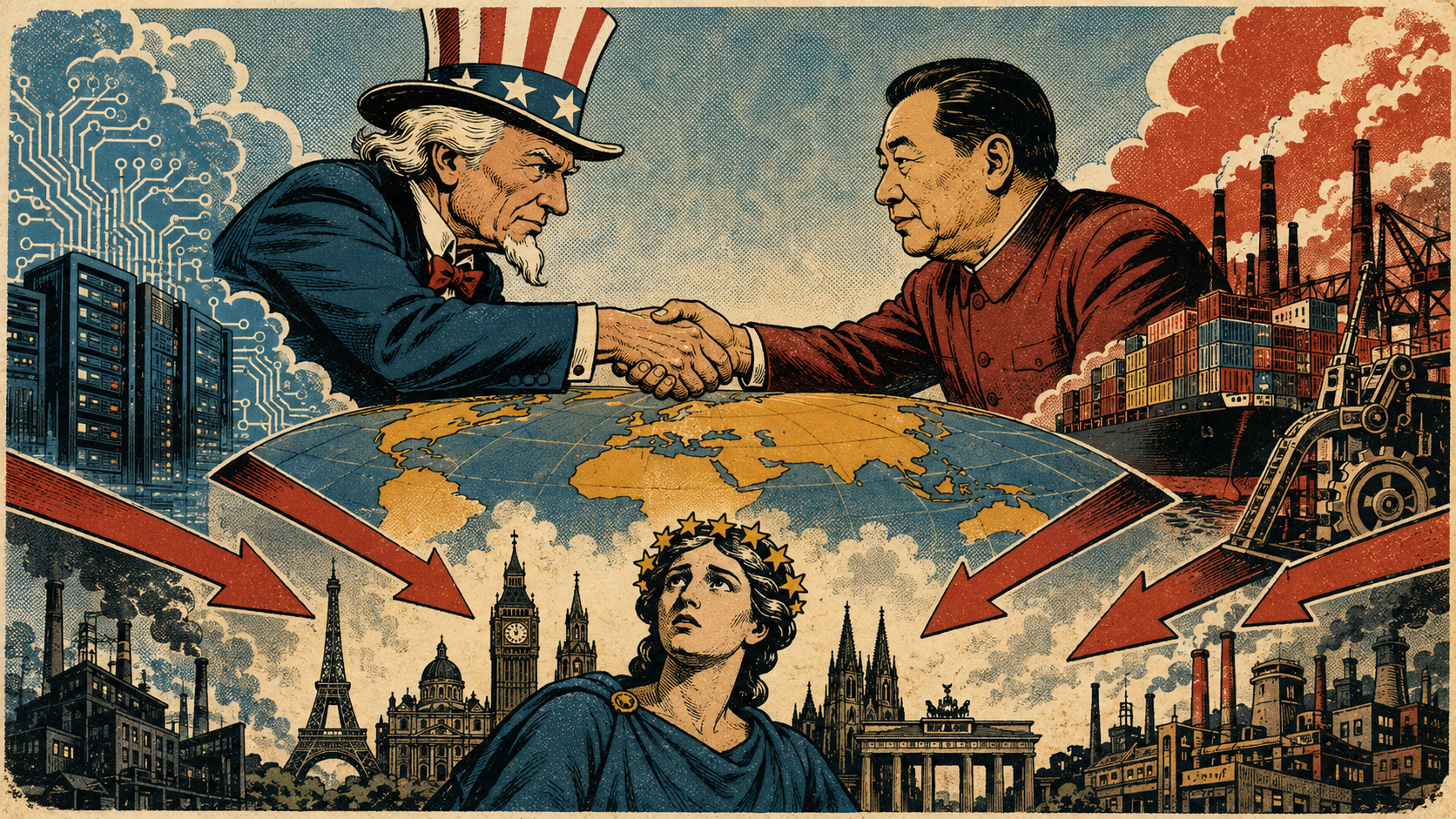
Why the biggest threat to European sovereignty may not be U.S.–China conflict, but a U.S.–China settlement
I think there is a geopolitical possibility that is still maybe three years ahead of mainstream discussion.
Most people assume the defining international conflict of the next several decades is already fixed:
United States vs. China.
A new Cold War.
Washington builds one technology bloc. Beijing builds another. Europe, India, Japan, Southeast Asia and everyone else maneuver between them.
Europe in particular seems to believe this rivalry gives it room to construct a “third pole”: European defense autonomy, European cloud, European AI, European industrial policy, European regulation.
I think that assumption could be badly wrong.
The largest geopolitical shock to Europe may not come from worsening U.S.–China relations.
It may come from improving U.S.–China relations.
Not friendship. Not an alliance. Not China becoming democratic or America accepting Chinese hegemony in Asia.
Just a deal.
A sufficiently durable settlement in which Washington and Beijing decide which economic relationships are acceptable, which technologies may cross the border, which markets remain protected, and which military confrontations are better left below the threshold of war.
Once that happens, an uncomfortable question appears:
Where does the enormous political and economic pressure currently directed by the United States and China at each other go instead?
My answer is increasingly: Europe.
Rivalry is currently giving Europe a subsidy
There is an underappreciated benefit to being the third player when the first two desperately want to defeat each other.
If America believes Europe could drift toward China, Washington has an incentive not to push Europe too hard.
If China believes Europe could fully align with America, Beijing has an incentive not to push Europe too hard either.
Europe receives what we might call swing-state rents.
Both sides want access to the European market. Both want European diplomatic support. Both worry about European technology ending up in the other's ecosystem.
That gives Europe optionality.
But optionality is valuable only while the two largest players are competing for you.
If they eventually conclude that there is more value in stabilizing their own relationship than in fighting over every third country, the calculation reverses.
Europe stops being the prize.
Europe becomes the market to be divided.
China is not the Soviet Union
One reason I think a U.S.–China settlement is more plausible than conventional Cold War analogies imply is simple:
China and America actually do enormous amounts of business with each other.
Even after years of tariffs, technology controls and “decoupling,” U.S.–China goods trade was still approximately $415 billion in 2025.
That is fundamentally different from the economic structure of the original Cold War.
A 1962 U.S. State Department policy review described trade with the Soviet Union as economically and commercially negligible from the American perspective.
The United States and Soviet Union could sustain an almost purely geopolitical rivalry because relatively little commercial value had to be sacrificed to maintain it.
The U.S.–China relationship is different.
American companies want parts of the Chinese market.
China wants American technology, agricultural products, finance and selected industrial goods.
American consumers and firms still consume Chinese production.
Chinese companies still have enormous incentives to reach American consumers.
The two governments can therefore simultaneously be strategic adversaries and have hundreds of billions of dollars of reasons to negotiate.
We are already seeing this pattern. The 2025 U.S.–China economic agreement included Chinese commitments on long-term purchases of American agricultural products and changes to restrictions involving rare earths and critical minerals.
That doesn't mean the rivalry is ending.
It means rivalry and bargaining can coexist.
And historically, that is normal.
Superpowers make deals more often than we remember
Our popular version of geopolitics tends to divide states into friends and enemies.
History is considerably messier.
Britain and the Soviet Union were wartime allies, yet Churchill and Stalin discussed explicit spheres of influence in Romania, Bulgaria, Greece and Yugoslavia. U.S. diplomatic records from the period straightforwardly describe a British-Soviet “spheres of influence arrangement.”
At Yalta, the Western allies made concessions concerning Soviet interests in East Asia in return for Soviet participation in the war against Japan.
Even the supposedly eternal U.S.–Soviet Cold War produced détente in the 1970s when both governments concluded that limiting parts of their confrontation served their interests.
Great powers don't need to like each other.
They only need to conclude:
We can get more by limiting our conflict here and bargaining with each other there.
That is why I don't think the relevant future scenario is a dramatic secret treaty dividing Europe.
It could be much more boring.
And therefore much more plausible.
Washington and Beijing could simply reach a series of agreements:
Certain Chinese products can enter America.
Certain American products and technologies can enter China.
Some export controls stay. Others disappear.
Certain industries remain strategically protected.
China guarantees some critical-material exports.
America gives Chinese firms more predictable treatment in selected sectors.
Both sides establish clearer red lines around military confrontation.
Taiwan remains unresolved, but the rules of escalation become more predictable.
Neither government gives up its strategic ambitions.
They simply stop spending quite so much political capital trying to economically strangle the other.
That alone changes the world.
Japan has already lived through the danger of being the ally
There is another assumption Europeans should question:
“America wouldn't deliberately damage the industrial position of an ally.”
Japan already tested that proposition.
In the 1980s, Japan was not an adversary of the United States.
It was one of America's closest allies.
It hosted American forces. It sat firmly inside the U.S.-led security system. It was on America's side in the Cold War.
None of that stopped Washington from applying extraordinary economic pressure once Japanese industrial power began threatening major American industries.
The 1986 U.S.–Japan Semiconductor Agreement was particularly revealing.
The Reagan administration explicitly said the agreement was designed not only to increase American semiconductor access to Japan, but also to prevent Japanese semiconductor dumping in third-country markets.
When Washington concluded Japan wasn't complying, Reagan announced tariffs on as much as $300 million of Japanese exports.
Think about what that means.
America wasn't merely protecting its own domestic market.
It was negotiating the competitive behavior of Japanese companies outside both Japan and the United States.
Then there was the Plaza Accord.
The Plaza Accord was not literally an American-European conspiracy to destroy Japan. Japan participated voluntarily alongside the United States, West Germany, France and Britain, and the immediate objective was correcting an extremely strong dollar and large external imbalances.
But Japan experienced enormous consequences from the resulting yen appreciation.
The Bank of Japan itself later wrote that the sharp yen appreciation following Plaza triggered the rapid transfer of Japanese production lines into other East Asian economies beginning in the late 1980s.
Manufacturing networks spread through Korea, Taiwan, Southeast Asia and eventually China.
Again, I am not arguing that Washington secretly designed a master plan saying:
“Destroy Japanese manufacturing and give it to China.”
History rarely works that cleanly.
The more important lesson is that Washington was willing to impose policies on an extremely close ally because America's economic interests had changed.
The downstream industrial geography then evolved for decades.
That is exactly the point Europeans should remember.
Being an ally does not guarantee that your industrial interests will be protected when they conflict with those of the hegemon.
Now imagine the same mechanism in AI
Europe is currently trying to construct technological sovereignty.
The European Commission explicitly talks about reducing strategic dependencies and building more sovereign European AI and cloud infrastructure. Its Apply AI strategy promotes a “buy European” approach, particularly in the public sector.
Europe is building 19 AI Factories and has launched plans for enormous AI Gigafactories. The Commission says these investments are meant to increase technological leadership, resilience and strategic autonomy.
On paper, this makes sense.
But sovereign AI doesn't work merely because you build a datacenter and train a European model.
You need demand.
You need procurement.
You need European governments and regulated industries willing to buy the European product even when an American or Chinese alternative is cheaper, larger or technically better.
That requires political protection of the ecosystem while it scales.
And this is precisely where a U.S.–China accommodation could become dangerous.
The pincer
Suppose America and China stop treating each other as the primary destination for their economic coercion.
Their interests toward Europe are different.
But they can become complementary.
China has enormous manufacturing capacity.
If substantial parts of the American market remain protected from Chinese goods, Chinese companies need somewhere else to sell.
Europe is one of the richest remaining markets in the world.
So Chinese pressure on Europe concentrates in:
EVs.
Batteries.
Solar.
Machinery.
Electronics.
Industrial components.
Eventually increasingly sophisticated capital goods.
China doesn't have to intend to deindustrialize Europe.
Its companies simply need customers.
America approaches from the opposite direction.
Its strongest European interests increasingly lie in:
AI.
Cloud.
Software.
Advertising.
Finance.
Intellectual property.
Aerospace.
Defense technology.
So Washington's pressure becomes:
Don't discriminate against American cloud companies.
Don't reserve government AI contracts for European providers.
Don't create digital rules specifically disadvantaging American platforms.
Don't subsidize European competitors while excluding American companies.
Keep your market open.
Now Europe has a problem.
China attacks the margins of Europe's physical economy.
America attacks the protected space Europe needs to create a digital economy of its own.
And Russia can simultaneously increase the security cost of remaining European.
This does not require coordination.
It doesn't require Xi and Trump sitting in a room discussing how to destroy Europe.
It merely requires each country pursuing its own interests.
The resulting structure could be:
China → European manufacturing
United States → European digital economy
Russia → European security costs
while Europe is simultaneously trying to finance pensions, defense, energy transition, semiconductor subsidies and sovereign AI.
That is the squeeze.
What twenty years of the squeeze could look like
It is easy to make this argument sound dramatic because the geopolitical mechanism is dramatic.
So let's put numbers on it.
Not because anyone can forecast Europe in 2046 to the decimal point.
But because there is an enormous difference between saying:
“Europe could decline.”
and saying:
“What would have to happen for Europe to end up 30% poorer than it otherwise would have been?”
The answer is: surprisingly little, if the damage compounds for twenty years.
Today the European Union is still an enormous economy.
The IMF puts EU GDP at roughly $23 trillion in 2026, with about 451 million people.
The mistake would be imagining that some geopolitical squeeze needs to make those $23 trillion disappear.
It doesn't.
Europe can remain wealthy.
Paris can still be beautiful.
Germany can still manufacture excellent machinery.
Dutch people can still have excellent infrastructure.
Europeans can still take vacations and live longer than Americans.
What changes is the trajectory.
Suppose a Europe that successfully maintained its security, industrial base and technological sovereignty could grow real GDP per person by around 1.2% a year over the next twenty years.
That isn't an Asian miracle.
It's fairly modest growth for an advanced economy.
Now imagine the world I have been describing.
America gradually stops acting as the unquestioned guarantor of European security.
Not necessarily leaving NATO.
Not necessarily announcing that Article 5 is dead.
Something subtler may be enough:
Russia intervenes somewhere on Europe's periphery.
Washington hesitates.
Russia probes again.
Washington says the Europeans need to handle their own neighborhood.
Every government and every investor now understands that a Russian military intervention in Europe no longer automatically produces overwhelming American involvement.
At the same time, China is redirecting industrial capacity toward Europe because much of the American market remains protected.
And American digital companies are increasingly focused on Europe because China remains partially closed to them.
Europe is now being squeezed simultaneously in:
security, physical industry and digital value capture.
How much does that actually matter?
Start with just growth
Suppose European real GDP per capita doesn't collapse.
It simply stagnates.
Instead of growing 1.2% annually, it grows 0%.
After twenty years, Europe is already roughly:
21% poorer than the Europe that could have existed.
Nothing catastrophic needed to happen in any particular year.
No Great Depression.
No 30% unemployment.
No destruction of Paris.
Just twenty years of:
1.2% becoming 0%.
Now make the environment slightly worse.
Suppose real GDP per person falls by 0.3% annually on average because investment is weaker, taxes are higher, capital moves elsewhere and repeated security crises periodically interrupt growth.
After twenty years, Europe is roughly:
26% behind the counterfactual.
Add just a 5% permanent level loss from one serious military/security crisis—capital destruction, disrupted trade, refugee flows, infrastructure spending, financial-market repricing—and the gap approaches:
30%.
Go one step further.
Suppose Europe averages −0.5% per-capita growth, with a 10% persistent level shock from repeated Russian military interventions or one major confrontation.
Now Europe ends up roughly:
36% poorer than the peaceful counterfactual by 2046.
And in a genuinely severe version—around −1% annual per-capita growth combined with a persistent 15% security shock—the loss gets close to:
45%.
Those aren't forecasts.
They're arithmetic.
And that's why I think the scale of the downside is easy to underestimate.
This isn't normal geopolitical uncertainty
The European Central Bank estimated that ordinary economic-policy uncertainty already subtracted around 0.4 percentage points from euro-area GDP growth between early 2025 and early 2026, primarily through weaker business investment.
That was uncertainty over tariffs, politics and policy.
Now imagine something much larger:
Investors stop assuming that major-power military conflict inside Europe is essentially impossible.
That changes the calculation for every thirty-year asset.
Imagine you're deciding where to build a €15 billion semiconductor facility.
Today you compare:
Germany.
Arizona.
Japan.
Maybe Singapore.
Under the new European regime, the spreadsheet gets another column:
Geopolitical risk.
Not:
“Will Russian tanks reach Dresden next year?”
That's the wrong question.
The question is:
“During the thirty-year life of this facility, what is the probability that Europe experiences military escalation, energy disruption, emergency taxation, infrastructure attacks, capital controls, political fragmentation or a major defense mobilization?”
If that probability rises enough, the fab doesn't have to leave Europe.
The next fab simply doesn't arrive.
The same thing happens with:
AI datacenters.
Battery plants.
Corporate headquarters.
Pharmaceutical laboratories.
VC funds.
Robotics factories.
Advanced-material plants.
Founders.
Researchers.
Capital allocation moves at the margin.
And the margin, repeated for twenty years, becomes economic geography.
Europe would also lose its postwar security discount
This is where I understated the problem earlier.
I initially treated Russian pressure mostly as:
Europe has to spend more on defense.
That's real, but it isn't the central issue.
EU defense spending is already projected at about 2.4% of GDP in 2026, or €454 billion.
NATO members have already committed to reaching 5% of GDP in combined defense and security-related spending by 2035, including at least 3.5% for core defense.
Under the scenario I am describing, 5% might not be the endpoint.
It might be the beginning.
If Europe concludes that America may not intervene when Russia tests the system, Europe suddenly has to reproduce capabilities that were effectively subsidized by the United States for generations.
Intelligence.
Missile defense.
Logistics.
Strategic lift.
Satellite systems.
Ammunition stockpiles.
Naval capacity.
Airpower.
Potentially a much larger independent nuclear deterrent.
It isn't difficult to imagine a Europe spending 6–8% of GDP on security for extended periods in the more severe version of this world.
Again, that spending doesn't vanish.
European defense companies would grow.
Engineers would get hired.
Factories would be built.
But opportunity cost exists.
A society simultaneously trying to fund:
pensions
healthcare
energy infrastructure
AI
semiconductor subsidies
universities
housing
defense
eventually has to choose.
And defense becomes the thing Europe cannot choose not to buy.
Meanwhile China comes through the factory gate
The Chinese side of the squeeze is different.
Suppose the United States and China settle into a managed trade relationship.
China gets predictable—but incomplete—access to America.
America gets predictable—but incomplete—access to China.
Military confrontation is bounded.
That sounds stabilizing.
For Europe it might not be.
Chinese productive capacity that cannot fully enter America still needs customers.
Europe is the richest obvious destination.
So twenty years of Chinese industrial upgrading starts hitting:
European automobiles.
Batteries.
Machine tools.
Chemicals.
Solar.
Electrical equipment.
Robotics.
Industrial components.
Heavy equipment.
Europe doesn't merely lose export share inside China.
That would be manageable.
The more damaging transition is:
European company loses China
↓
Chinese company gains scale in China
↓
Chinese company enters Europe
↓
Chinese company competes with European company in third markets.
That is a completely different problem.
The European producer gets attacked in all three places simultaneously.
China.
Europe.
The rest of the world.
There is no reason to assume the European automotive industry disappears.
But imagine its internationally competitive footprint shrinks by a third.
Then add similar pressure across machinery, chemicals and clean-energy manufacturing.
You can easily get millions of workers moving out of high-productivity traded industry over twenty years.
They don't necessarily become unemployed.
They become healthcare workers.
Government employees.
Hospitality workers.
Construction workers.
Local-service employees.
Perfectly useful jobs.
But economically something has changed.
A worker producing a globally exported €80,000 machine is operating inside a different productivity and capital ecosystem from a worker providing a local service.
This is how deindustrialization can occur without mass poverty.
America takes the other side
Then there is AI.
Europe may still consume enormous quantities of AI.
European companies may become dramatically more productive because of AI.
European doctors might use American medical models.
European lawyers might use American legal agents.
European factories might run American industrial AI systems.
European governments might operate American foundation models inside European datacenters.
That doesn't mean Europe captured the value.
The crucial distinction is:
using a technology is not the same thing as owning the capital layer producing its rents.
If the next twenty years create trillions of dollars of value through:
AI models.
Cloud infrastructure.
Enterprise software.
Agent platforms.
Data-center infrastructure.
Advertising.
Financial platforms.
Digital intellectual property.
then where does the equity value accumulate?
San Francisco?
Seattle?
New York?
Or Paris, Berlin and Milan?
Europe can get the consumer surplus while America gets much of the producer surplus.
Europeans get wonderful AI.
American shareholders get the compounding ownership claim.
And if Washington successfully pressures Europe not to create strong procurement preference for European AI, Europe's attempt to build a sovereign ecosystem gets even harder.
The European taxpayer can fund the datacenter.
Then an American model runs on it.
That is not technological backwardness.
It's technological dependency with excellent user experience.
Then the compounding starts
Now combine the three.
Russia raises the risk premium.
Long-term capital becomes more cautious about Europe.
China compresses European manufacturing margins.
Industrial profits and export rents decline.
America captures much of Europe's digital value creation.
The next generation of high-margin platforms is disproportionately owned elsewhere.
Then the effects reinforce one another.
Lower corporate profits mean less R&D.
Less R&D means weaker productivity.
Lower productivity makes defense spending more painful.
Higher defense spending means higher taxes or less civilian investment.
Higher taxes and weaker growth make mobile founders and capital more likely to leave.
That lowers the future tax base.
Which makes defense and welfare spending even harder.
This isn't a one-time shock.
It's a feedback loop.
So what does Europe look like in 2046?
Here is my central adverse scenario.
Not the worst case.
Not nuclear war.
Not Russian occupation of Western Europe.
Just twenty years in which the security regime deteriorates and the economic squeeze persists.
Europe's real GDP per capita ends up roughly:
25–35% below where it plausibly could have been.
In a more severe case where Russia demonstrates through actual military interventions that American involvement is no longer reliable:
35–45% below the counterfactual is not difficult to construct mathematically.
That doesn't mean GDP per capita falls 45% from today's level.
That's an important distinction.
Europe may still be somewhat richer in 2046 than it is today.
The tragedy is that everyone else moved much further.
Imagine:
European living standards: +5% or +10% over twenty years.
while:
American living standards: +40% or +50%.
The average European isn't destitute.
He simply discovers that an American doing a comparable globally tradable job earns two or three times as much.
European companies struggle to buy American technology companies because American valuations have become enormous.
European universities struggle to retain the best researchers.
European governments find defense systems priced in dollars extraordinarily expensive.
European entrepreneurs increasingly discover that raising capital in America means eventually moving there.
The relative gap becomes the power gap.
Europe's global weight could almost halve
Europe today accounts for roughly 18% of nominal world GDP using current IMF figures.
If the rest of the world keeps growing while Europe stagnates, that share falls mechanically.
Under the sort of twenty-year differential described above, I could imagine the EU ending up around:
7–10% of nominal world GDP by the mid-2040s.
Again, that doesn't require European GDP collapsing.
It requires:
America continuing to grow.
Asia continuing to grow.
Europe barely doing so.
A weaker euro associated with geopolitical risk could push the nominal share lower still.
This is very similar to what makes Japan such an interesting historical warning.
Japan didn't become poor.
Tokyo didn't turn into a failed city.
Japanese people didn't lose the ability to manufacture sophisticated products.
Japan simply went from appearing capable of becoming one of the central organizing economic powers of the world to occupying a much smaller relative position several decades later.
The world grew around it.
And perhaps the clearest signal would be migration
I don't expect Europeans to flee by the tens of millions.
Europe would still be one of the nicest places on Earth to live.
The migration that matters would be much more selective.
The 27-year-old machine-learning researcher.
The founder who wants a $30 million Series A.
The semiconductor engineer.
The ambitious surgeon.
The quantitative trader.
The robotics entrepreneur.
The scientist who wants a laboratory with unlimited compute.
Imagine Europe loses only an additional 100,000–250,000 highly mobile people per year relative to the peaceful counterfactual.
Across twenty years, that's roughly:
2–5 million people.
Against a population above 400 million, it looks trivial.
But if those people disproportionately contain the future founders, researchers and capital allocators, it isn't trivial at all.
It becomes another compounding mechanism:
talent follows capital
↓
companies follow talent
↓
capital follows companies
↓
the next generation of talent follows all three.
This is the part that makes the scenario dangerous
A Russian tank does not have to reach Berlin.
China does not have to destroy Volkswagen.
America does not have to ban Mistral.
The United States does not even have to formally leave NATO.
The squeeze works at the margin.
One factory goes elsewhere.
One founder leaves.
One European model loses a government contract.
One Chinese competitor takes another three percentage points of market share.
One Russian intervention raises the discount rate another 50 basis points.
One defense budget takes another percentage point of GDP.
Do that repeatedly for twenty years.
Then in 2046 someone writes an article asking:
How did Europe become only 8% of the world economy?
And everyone produces a list of fifty explanations.
Demographics.
Regulation.
AI.
China.
Russia.
Energy.
America.
Taxes.
Investment.
The answer may be simpler.
Europe spent twenty years absorbing the adjustment costs of a new great-power settlement.
And because the losses arrived one investment decision at a time, nobody recognized the historical transition while it was happening.
The most dangerous demand might sound completely reasonable
Imagine Washington tells Europe:
“We aren't asking you to stop building European AI. We just want fair competition. No discriminatory procurement. American companies must receive equal access.”
That sounds almost benign.
But suppose Europe has spent €20 billion building sovereign compute while European model companies remain one-tenth or one-hundredth the scale of American competitors.
Equal competition at that moment may not be neutral.
It may mean the death of the European ecosystem.
Google, Microsoft, Amazon, OpenAI and Anthropic have enormous home-market scale, capital and distribution.
Europe's sovereign providers need anchor customers precisely because they don't yet possess those advantages.
Remove preferential procurement and the system can become:
European taxpayers fund compute.
American models capture the users.
European companies become integrators.
And twenty years later everyone asks why Europe has no major AI platform.
The agreement that caused it may have looked like an obscure procurement clause.
This is how forty-year outcomes are created
We tend to imagine historical turning points as spectacular events.
Wars.
Revolutions.
Financial crashes.
Often the more durable changes begin with boring agreements.
An exchange-rate agreement changes manufacturing economics.
A semiconductor agreement changes competitive behavior.
A procurement agreement changes who gets initial scale.
A security agreement changes the risk premium investors assign to a country.
Capital then compounds around the new equilibrium.
Factories attract suppliers.
Suppliers attract engineers.
Engineers generate startups.
Startups generate capital markets.
Capital markets finance the next generation.
Eventually the original political decision disappears from memory and the resulting industrial geography looks natural.
Japan's post-Plaza movement of production into East Asia is a useful example. The Bank of Japan explicitly connects the yen's appreciation after 1985 with Japanese companies rapidly moving production lines throughout East Asia.
Nobody in 1985 needed a forty-year master plan.
They only needed to alter the incentives governing the next factory.
Europe may be preparing for the wrong geopolitical problem
The mainstream European discussion today is increasingly:
How do we become sovereign in a world divided between America and China?
I think the harder question is:
What happens if America and China decide they don't need to remain maximally divided?
Europe's strategy implicitly assumes permanent great-power competition.
Permanent rivalry means both sides need Europe.
But great-power rivalry isn't necessarily permanent at maximum intensity.
Especially when the two powers still trade hundreds of billions of dollars with each other.
Especially when both have domestic economic problems.
Especially when military confrontation is catastrophically expensive.
Especially when a negotiated division of acceptable economic interaction can make both richer.
A U.S.–China settlement wouldn't have to end the rivalry.
It only needs to bound it.
Once it is bounded, Europe loses some of the geopolitical rent it receives from sitting between them.
And then something subtle happens.
Washington looks west and sees the world's richest remaining foreign market for American digital platforms.
Beijing looks west and sees the world's richest remaining foreign market for Chinese physical production.
Moscow looks west and sees a security environment in which American intervention may be less automatic than Europeans assumed.
Nobody has to agree on Europe.
Europe simply becomes where their interests converge.
Maybe this sounds three years early
Right now, the mainstream debate is still mostly about decoupling.
Will America and China separate?
Which countries choose which bloc?
Can Europe become the third pole?
Those are reasonable questions.
But I suspect the more consequential question will eventually become:
What happens after the two superpowers discover that permanent maximum confrontation is more expensive than a managed duopoly?
The Soviet analogy may have misled us.
The Soviet Union and America had very little economic relationship to preserve. China and America do.
That makes bargaining more likely.
And when great powers bargain, smaller powers should never assume their existing alliances guarantee that their economic interests will be protected.
Japan learned that in the 1980s.
Europe may learn it next.
The great danger for Europe is therefore not necessarily that America chooses China over Europe.
It is not that China chooses America over Europe.
It is something much less dramatic:
America and China choose a workable relationship with each other—and discover that both can get more of what they want from Europe afterward.
That deal may never mention Europe.
It may still reshape Europe for the next forty years.