
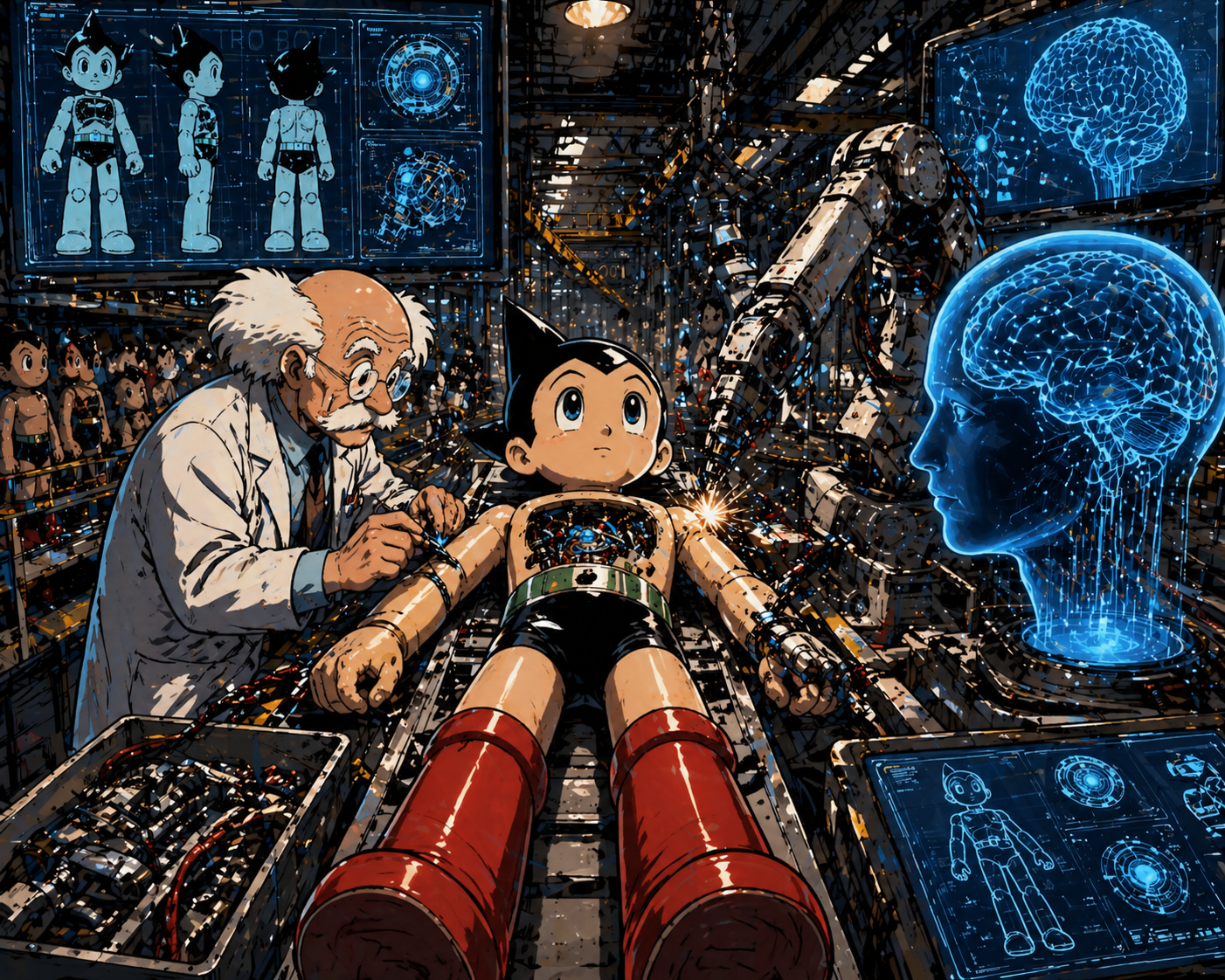
The current physical AI story is very cinematic.
Humanoid robots walking around factories. Robot workers carrying boxes. Robot butlers eventually folding laundry, delivering tools, doing last-mile tasks, replacing the human body inside the economy.
It looks cool. It photographs well. Investors like it. Journalists understand it. The demo has legs — literally.
But I think the thesis is probably wrong, or at least badly aimed.
The biggest economic impact of AI in manufacturing will probably not come from humanoid robots replacing workers inside messy production systems.
It will come from using AI to redesign the product and manufacturing process so the mess disappears in the first place.
In other words:
Humanoids optimize around human-designed complexity.
AI-assisted industrial design removes the complexity.
That is the real prize.
The Factory Is Not a Human Workplace. It Is a Scale Machine.
A factory is not mainly a place where humans do tasks.
A factory is a machine for producing repetition.
The core logic of manufacturing has always been:
standardization → specialization → repetition → scale economies
This is why classic robotics worked so well in automotive and electronics manufacturing. A robot arm does not need to understand the world. It needs to repeat the same high-value motion very fast, very accurately, and very cheaply over millions of cycles.
That is the magic.
Not intelligence.
Repetition.
Japan understood this deeply. Germany understood it. Toyota understood it. Fanuc, Yaskawa, ABB, Kuka — their world is not “general intelligence.” Their world is precision, throughput, reliability, uptime, and repeatability.
A humanoid robot enters the story when the environment is too messy for that model.
It can walk around. It can open doors. It can move through human-designed spaces. It can maybe handle irregular objects, fetch tools, inspect things, carry parts, or do tasks that were not worth automating before.
That has value.
But economically, that means humanoids are often attacking the residue: the awkward, irregular, low-volume, last-meter tasks that traditional automation could not justify.
Sometimes that residue is valuable. Sometimes it is just annoying.
Generality Is Technically Impressive. Specialization Is Economically Powerful.
This is the central tension.
A humanoid robot is impressive because it is general.
But factories make money by removing generality.
A specialized machine that performs one task extremely well can destroy a general machine that performs many tasks slowly and unreliably.
This is why the humanoid thesis feels slightly confused. It tries to preserve the human-shaped world and then build a machine that survives inside it.
But why preserve the human-shaped world?
If AI is powerful, the better use is not necessarily:
“Make robots that can operate in messy human environments.”
The better use may be:
“Redesign the product, tooling, workflow, and factory layout so the environment becomes less messy.”
That is a much stronger productivity lever.
The Real Opportunity: AI for Automation-Native Design
The boring acronym here is DFM/DFA:
Design for Manufacturability.
Design for Assembly.
These ideas are old. But AI could make them much more powerful.
The goal is simple:
- reduce part count
- reduce moving parts
- reduce assembly steps
- reduce tolerance complexity
- reduce manual handling
- reduce fasteners
- reduce inspection burden
- reduce failure points
- reduce changeover time
- reduce rework and scrap
- make parts easier for machines to pick, align, insert, inspect, and test
That sounds much less exciting than a humanoid robot doing a backflip in a warehouse.
But the economics are better.
If AI helps redesign a product so it has 35 parts instead of 120, that affects every unit produced.
If AI removes three assembly stages, that changes the whole factory flow.
If AI designs a component so it can be assembled by simple high-speed automation instead of a flexible robot, that is real surplus.
If AI reduces defects, rework, downtime, or tooling complexity, the gain may be bigger than replacing a few human workers.
The largest gains in manufacturing often come from restructuring the production function, not from inserting a smarter worker into a bad process.
Humanoids Are a Patch. Design Is a Cure.
A humanoid robot is often a patch for legacy complexity.
The factory is human-designed.
The tools are human-designed.
The shelves are human-designed.
The tasks are human-shaped.
So we build a human-shaped robot.
Fine. That makes sense for brownfield environments.
But that is not the highest form of automation. That is retrofit automation.
The more powerful move is to ask:
Why does this process need a human-shaped actor at all?
Maybe the product has too many parts.
Maybe the assembly sequence is stupid.
Maybe the fasteners are badly chosen.
Maybe the tolerance stack is too fragile.
Maybe the object is hard to grip because nobody designed it for robotic handling.
Maybe the process exists because it made sense in 1998 and nobody has touched it since.
This is where AI can matter.
Not as a metal person walking around.
As an industrial co-designer that constantly asks:
“Why is this hard to manufacture?”
That is the trillion-dollar question.
The LLM Analogy Misleads People
Part of the physical AI hype comes from people trying to copy the LLM story.
LLMs scaled fast because software scales by copying.
Once the model exists, it can be deployed everywhere at low marginal cost. Text, code, images, reasoning, documents, customer support, search, analytics — the surface area is huge.
Robots are different.
Robots live in the world of atoms.
Every robot needs hardware.
Every robot has motors.
Every robot breaks.
Every robot needs maintenance.
Every robot consumes space, energy, and capital.
Every robot has safety risk.
Every robot must physically show up.
Software scales by replication.
Factories scale by repetition.
Humanoids only scale if messy tasks become repeatable enough.
That is a much harder path.
The Japan Supercomputer Warning
China’s massive state-backed investment into embodied AI reminds me a bit of Japan’s old state-backed supercomputer and Fifth Generation computing push.
The story then was: Japan would leapfrog the next computing paradigm through industrial policy, hardware, and national coordination.
It did not work out that way.
The world did not move toward Japan’s chosen abstraction. It moved toward microprocessors, workstations, PCs, Unix, the internet, GPUs, and eventually statistical AI.
That does not mean China’s robotics push will fail completely. China has a much stronger manufacturing substrate for robotics than Japan had for symbolic AI computing. China has factories, motors, batteries, sensors, supply chains, subsidies, and customers.
But the warning is still valid:
State capital can amplify the wrong thesis very efficiently.
If the thesis is “humanoid robots become universal labor,” I am skeptical.
If the thesis is “AI makes factories more adaptive and automation easier,” that is much more believable.
The Real Physical AI Boom May Look Boring
The winning version of physical AI may not be robot workers everywhere.
It may look like:
- AI-generated manufacturing plans
- AI-assisted product redesign
- automatic part-count reduction
- assembly-sequence optimization
- simulation-driven process design
- tolerance and material optimization
- robotic-handling-aware CAD feedback
- inspection and yield prediction
- factory-layout optimization
- flexible cells instead of universal humanoids
This is not sexy.
No one claps when a model reduces a bracket from nine components to two.
No one makes a viral video when an AI suggests a tolerance change that removes a manual inspection step.
But that is where the money is.
The economy does not care which demo looked cooler.
The economy cares what reduces cost per unit, increases yield, improves throughput, and compounds over millions of units.
The Better Thesis
So my contrarian view is this:
The biggest impact of AI in manufacturing will not be humanoid robots doing human tasks. It will be AI redesigning products and processes so traditional automation becomes easier, faster, cheaper, and more scalable.
Humanoids are useful where we cannot redesign the world.
But the real industrial revolution comes when we can.
This is the difference between:
“Can we build a robot smart enough to handle complexity?”
and:
“Can we use intelligence to remove the complexity?”
The second question is much more powerful.
Because the greatest factory is not the one filled with the smartest robots.
The greatest factory is the one where the process is so well designed that it barely needs intelligence at all.