
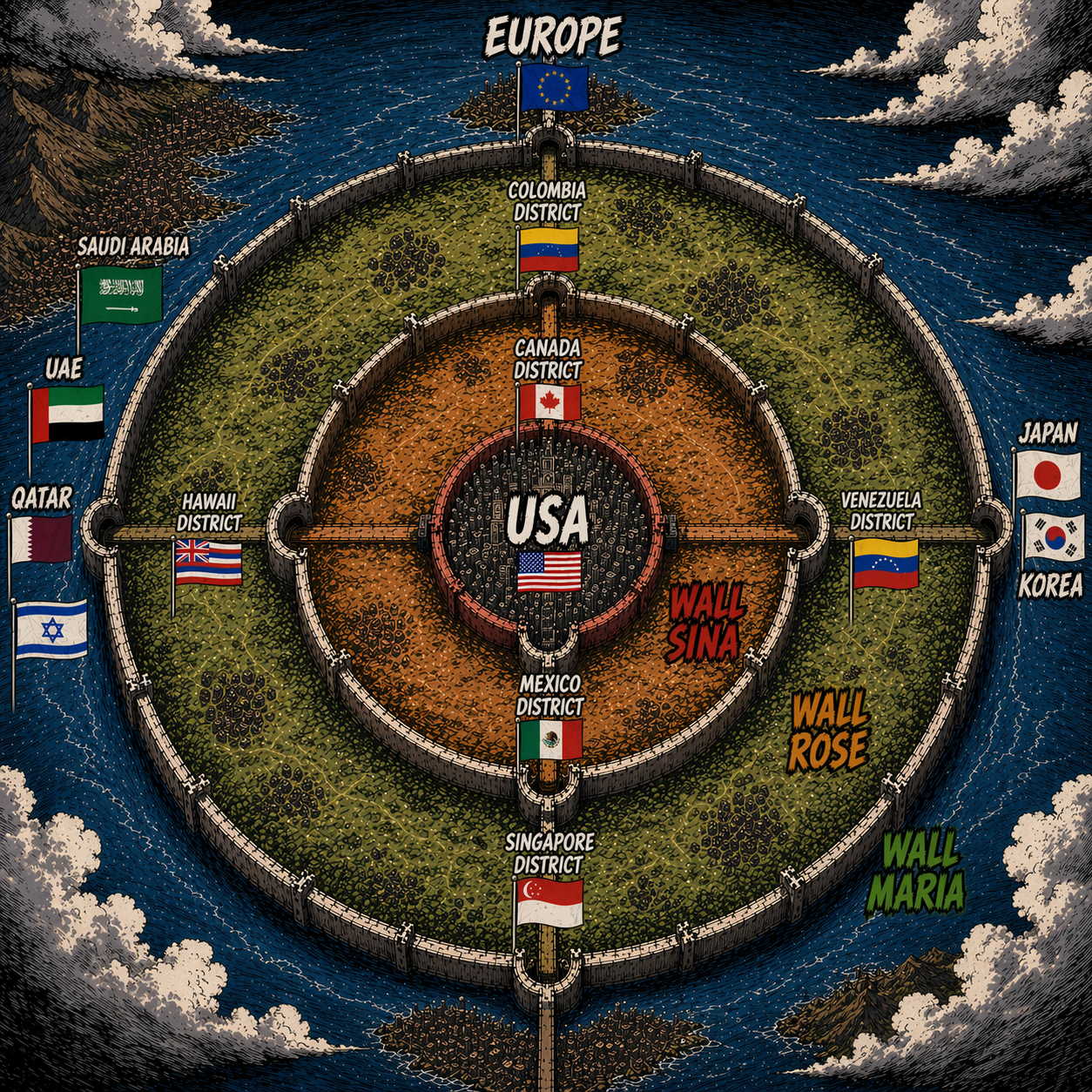
Most people watched Attack on Titan and saw monsters.
The sharper read is military history.
It is a story about a ruling order that decides the world is too expensive to manage, too dangerous to keep open, and too unstable to trust. So it does what declining powers always fantasize about doing: pull inward, harden the perimeter, simplify the moral story, and tell the people inside the wall that peace can be bought through closure.
That is why it feels so current.
The United States under the current administration is not literally becoming Paradis Island. But it is sketching a recognizable fortress logic. The FY2027 budget keeps border security and immigration enforcement central. The administration has also pushed a more transactional foreign posture, including a “trade over aid” message to allies and partners. At home, it has tightened H-1B selection rules for FY2027 and kept pressure on universities through probes and funding threats tied to protests, foreign funding, DEI, and other culture-war battlegrounds. (The White House)
And the American version of the wall is not just immigration control.
It is energy sovereignty plus forced reindustrialization.
The administration’s instinct is not merely to keep people out. It is to make the continental core harder to blackmail. That means treating oil, gas, refining, logistics, grid equipment, and baseload power as instruments of sovereignty. It also means using tariffs, procurement, and national-security language to pressure more manufacturing and strategic supply chains back onto U.S. or North American soil. That is not just campaign nostalgia about “bringing jobs back.” It is a more coercive attempt to drag the physical base of power back inside the perimeter. The recent Defense Production Act determinations on petroleum, coal, grid infrastructure, and large-scale energy infrastructure make that direction unusually explicit. (The White House)
This is the bridge to Attack on Titan.
In that story, the wall is never just concrete. It is a sorting machine.
When Wall Maria falls, the center does not save everyone equally. The monarchy does not level with the population and reorganize society honestly. It pulls the refugees inward, preserves the inner order as long as possible, and then sends masses of displaced people on the so-called mission to retake Wall Maria. The slogan is sacrifice for humanity. The underlying logic is simpler: too many mouths, not enough food, protect the center first.
That is what retreat looks like in the anime.
The people closest to the core survive longest.
The people in the middle get language.
The people on the edge pay the bill.
That is what I meant earlier, now in concrete terms.
The inner circle gets stabilization: Wall Sheena, the monarchy, the nobles, the people nearest the regime.
The outer circle gets ideology: patriotism, sacrifice, hope, “humanity’s fight.”
The abandoned perimeter gets history: Wall Maria’s refugees, the districts turned into bait, the people who absorb the real cost.
And history is not kind to frontier populations.
That is also why the political sequence in the story is so sharp.
First comes fear: the breach, panic, collapse.
Then simplification: outside is monsters, inside is safety, obedience is survival.
Then moral ranking: nobles matter more than refugees, interior order matters more than outer lives, regime stability matters more than truth.
Then policy: censorship, memory management, suppression, rationing, and disposable campaigns.
That is not abstract. That is the actual machinery of the world Isayama built.
The Military Police protect the interior.
The truth is hoarded.
Curiosity is punished.
The Survey Corps is glorified publicly but often treated structurally as a disposal mechanism for the restless and the expendable.
And when pressure rises, the system does not become more honest. It becomes more selective.
That is why the real question in Attack on Titan is never just “is there order?”
It is: order for whom?
The walls are not equally built for everyone.
They protect the regime first.
They protect the nobility next.
They protect the illusion of stability after that.
Everyone else is protected conditionally, until the arithmetic turns against them.
That is the part people sentimentalize away when they talk about “retrenchment” or “pulling back” in real politics, as if a great power can just shrink gracefully and everybody involved will calmly adjust.
No.
Retreat is not neutral.
It is distributive.
Some people get insulation.
Some get uncertainty.
Some get sacrificed.
And Attack on Titan pushes the point even harder with Marley.
The people left behind by King Fritz are not simply neglected. They are reorganized into subordinate roles. Eldians in Marley are forced into internment zones, marked with armbands, trained to internalize shame, and turned into usable populations. Some become Warrior candidates, taught to die for the empire that despises them. Others are literally transformed into Titans and dumped onto Paradis as biological waste and military utility. Even on Paradis, the same logic appears in softer form: refugees become surplus bodies, and royal blood becomes strategic livestock. Historia is not treated first as a person with a life of her own, but as a vessel for regime necessity.
That is why the line about the “left behind” matters.
They are not merely poor.
They are not merely unfortunate.
They are repositioned for subjugation.
Not always by chains.
Sometimes by dependency.
Not always by camps.
Sometimes by legal precarity and inherited humiliation.
Not always by direct conquest.
Sometimes by being stranded inside somebody else’s security design.
Not always by open censorship.
Sometimes by having every institution around you narrowed until your possible life becomes smaller.
The brutality in Attack on Titan is not only people being eaten.
It is also the narrowing of futures.
A child in Liberio does not begin with an open horizon. He begins under surveillance, humiliation, and military conditioning. A refugee from Wall Maria does not merely lose a house. He loses status, security, and the range of futures he might have had. Historia loses the right to an ordinary life. Even the Scouts, for all their heroism, are also part of a machine that consumes people whose temperaments cannot fit inside the wall.
That is what a hardened political order does.
It does not merely kill.
It allocates possible lives.
This is where the U.S. analogy becomes interesting.
The current administration’s fortress logic is not simply about “being tougher.” It implies a ranking of what the state now considers worth saving first: border control, continental energy, industrial capacity, selected strategic sectors, and a more openly transactional definition of alliance value. Europe is already discussing alternative security arrangements because of U.S. rhetoric around NATO and alliance burden-sharing. Meanwhile, the China policy looks less like confident global management than a jagged mix of tariff escalation, reversals, and improvisation. (Reuters)
That does not mean America is literally sealing itself off tomorrow. It means the governing instinct is shifting toward a civilization that trusts openness less than before.
And once that instinct matures, the danger is not only what happens outside the wall.
It is what happens inside.
Attack on Titan is very clear on this point: retreat can buy time, but it also distorts the society doing the retreat. The Walls protect Paradis for a while, but they also produce managed ignorance, class insulation, censorship, and a regime that fears unscripted knowledge almost as much as it fears external attack.
That is why the “America can just retreat and be fine” thesis is too neat.
A fortress can harden energy supply.
A fortress can drag factories home.
A fortress can reduce some vulnerabilities.
A fortress can even feel strong for a time.
But it also tends to become more suspicious of openness, more punitive toward permeability, more obsessed with discipline, and more willing to decide that some populations, some institutions, and some regions are now secondary to the stabilization of the core.
That is not a side effect.
That is the political price of the wall.
Lessons learned
1. Retrenchment is not peace.
In Attack on Titan, the center survives longer by shifting pain outward. In real politics, great powers often do the same.
2. Oil independence and reindustrialization are not just economic programs.
They are the material language of a state trying to reduce dependence on the outside world. (The White House)
3. Every wall is also a ranking system.
Wall Sheena is not Wall Maria. The interior is not the frontier. Protection is not distributed equally.
4. The left behind are rarely left alone.
In the anime, Eldians outside the king’s protection are not set free; they are reorganized under harsher masters. That is often the real fate of abandoned peripheries.
5. The deepest cruelty is often not spectacular violence.
It is the narrowing of futures: who gets a life, who gets a role, who gets used, and who gets sacrificed.
6. A fortress state eventually starts fearing dynamism itself.
Once stabilization becomes the supreme value, curiosity, openness, and institutional independence start looking like threats.
That is the brilliance of Attack on Titan.
It understands that a wall is never just a defense project.
It is a moral accounting system.
It is an industrial accounting system.
It decides whose insecurity will be reduced, whose insecurity will be exported, and which factories, energy systems, and institutions are too strategic to leave outside the perimeter.
That is why the show still lands.
Not because giants are scary.
Because retreat is.
And because every retreating power tells the same lie:
that the people outside the wall are unfortunate,
rather than chosen.