
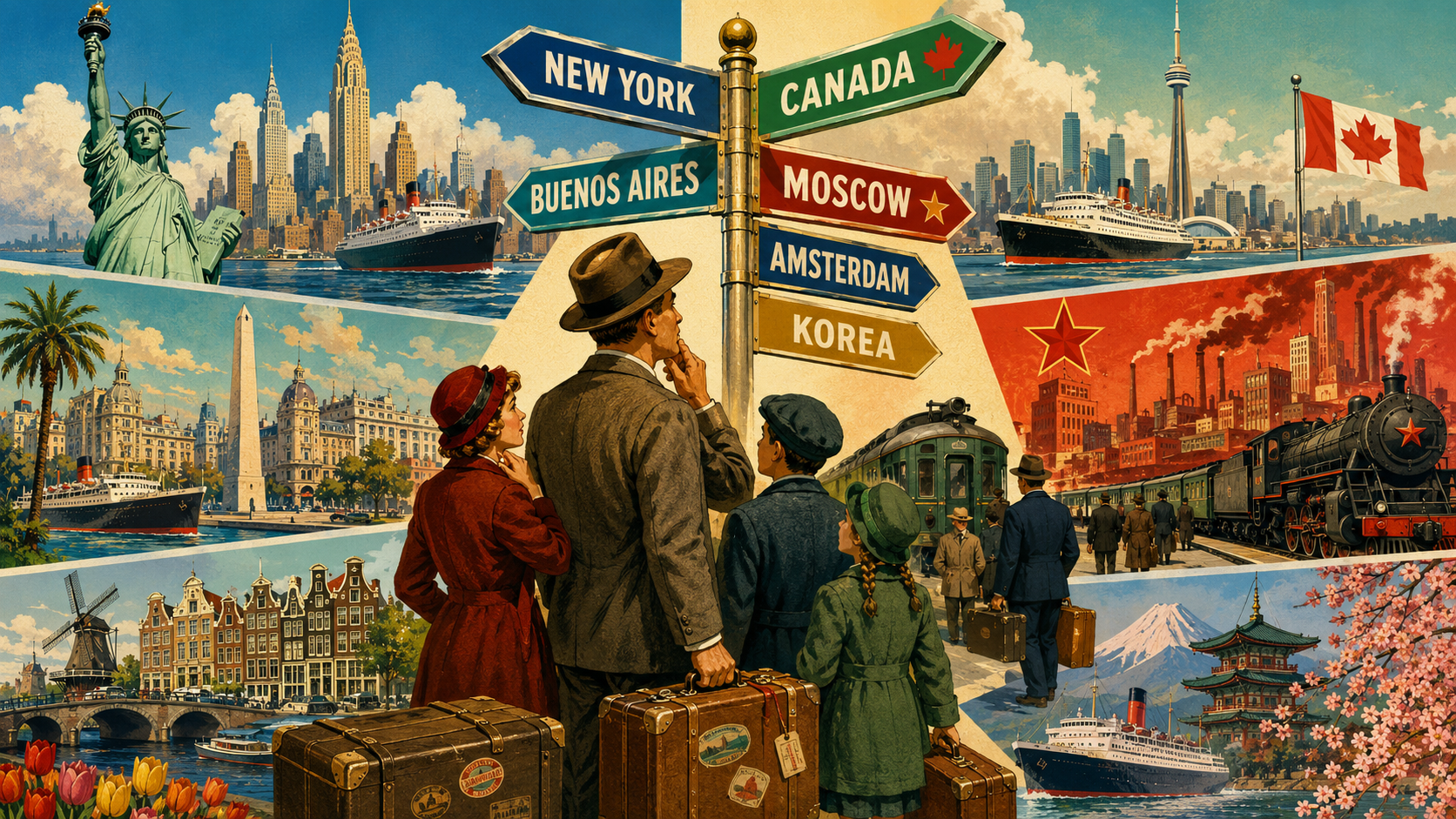
If you had to choose where your family would live for the next 30 years, what could you actually know in advance?
One of the strangest things about looking back at the great migration era of the 20th century is where people ended up.
Some Europeans moved to the United States and Canada.
Others chose Argentina or Brazil.
Some emigrants returned to the Soviet Union.
People moved to revolutionary China.
Beginning in 1959, more than 90,000 Koreans and their family members left Japan for North Korea.
German Jews escaping Nazi persecution scattered across Britain, France, the Americas, Palestine, Shanghai and dozens of other destinations.
From the perspective of 2026, some of these choices look brilliant.
Others look catastrophic.
The temptation is to think:
How could they possibly have chosen that country?
But that's cheating.
We know what happened next.
They didn't.
A migrant deciding where to go in 1925 did not know that Hitler would take power in Germany, that Stalin's USSR would become what it became, that Mao would win the Chinese Civil War, that North Korea would become one of the world's most closed states, or that the United States would dominate the postwar international system.
So I've become interested in a different question:
Was there a simple piece of information available at the time that could have improved your odds without requiring you to predict history?
I think there was.
Look at how much capital the country had already accumulated—especially how much of the rest of the world it owned.
In other words:
Before immigrating to a country, look at its balance sheet.
Most migration advice focuses on the present
People choosing countries today tend to ask:
- Where are salaries highest?
- Where are the best jobs?
- Which city is exciting?
- Where is immigration easiest?
- Which society is tolerant?
- Where are taxes lower?
- Which country is growing fastest?
- Where do successful people seem to be moving?
These are perfectly reasonable questions if you're choosing where to spend three years.
They are much less obviously sufficient if you're choosing where your children may still be living in 2050.
Migration is an unusually long-duration bet.
You are placing your career, savings, property, legal status, social network and possibly your descendants under one sovereign government.
Yet people often choose countries using what amounts to a five-year momentum strategy:
This economy is booming.
This city is cool.
Everyone is moving there.
The government currently welcomes people like me.
History gives us plenty of examples of why this can go badly.
But to understand them, you have to resist looking backward from the outcome.
You have to put yourself in the migrant's shoes.
Put Yourself in Their Shoes
Forget for a moment what you know about the second half of the 20th century.
You don't know that America becomes America.
You don't know what Stalin is going to do.
You don't know Argentina's long relative decline.
You don't know what North Korea becomes.
You have to choose using only what is visible at the time.
Choice #1: You are a Finnish worker in Canada in 1931
You left Finland years ago and now live somewhere around Ontario's mining and lumber country.
Then the Great Depression hits.
Jobs disappear.
Capitalism does not look particularly impressive.
American unemployment is exploding. Canadian workers are suffering too. Banks are failing. Commodity prices are collapsing. The entire North American economic system seems to be malfunctioning.
Meanwhile, across the Atlantic, something very different is happening.
The Soviet Union is industrializing at extraordinary speed.
Soviet Karelia actively wants people like you.
You speak Finnish. You know machinery. Maybe you're a carpenter, miner, logger, engineer or mechanic.
And Soviet recruiters aren't saying:
Come and scrape by.
They're saying, in effect:
Come help build a new society.
There is even a Finnish-speaking socialist project being constructed in Karelia.
For a working-class Finnish immigrant who had already experienced labor conflict and discrimination in North America, this was not necessarily ridiculous.
Thousands agreed.
About 6,500 Finnish Americans and Canadians moved to Soviet Karelia in the early 1930s. They brought labor, skills, money, machinery and tools badly needed by the Soviet economy.
Now stop.
It is 1932.
Which country looks as though it has momentum?
Canada and the United States are experiencing the worst economic collapse in modern memory.
The Soviet Union is putting up factories.
If your migration heuristic is:
Go where things are growing.
the USSR doesn't look insane.
It may even look intelligent.
Now jump forward six years
The North American depression eventually ends.
The United States goes on to become the dominant economic power of the second half of the century.
Canada becomes one of the world's wealthiest societies.
And in Soviet Karelia?
The Great Terror arrives.
North American Finns become targets of the purges. Hundreds of Finnish Canadians are estimated to have been among Stalin's victims.
Think about how extraordinary the reversal was.
These people had already successfully crossed the Atlantic and reached Canada or the United States.
Then, during a temporary economic disaster, some voluntarily traded that position for Soviet residence and, in many cases, a future they could no longer easily escape.
With hindsight:
Canada → USSR
looks incomprehensible.
From inside 1931?
Much less so.
And this is precisely where the balance sheet may have told you something that current economic growth did not.
The Depression had destroyed income and employment in North America.
It had not destroyed the enormous stock of accumulated North American capital underneath the economy.
The United States had already transformed from a net international debtor before World War I into a creditor nation after the war.
The Soviet Union was the opposite kind of bet: an extraordinarily ambitious society attempting to create capital at breathtaking speed after revolution, civil war, expropriation and destruction.
One country looked broken because its current output had collapsed.
The other looked dynamic because its current output was accelerating.
But one already possessed a gigantic accumulated balance sheet.
The other was trying to build one.
For a 30-year migration decision, that distinction mattered much more than the 1931 unemployment rate.
Choice #2: You are Italian in 1905. New York or Buenos Aires?
This one is harder because Argentina was not an obviously bad choice.
Imagine you're a young Italian in 1905.
You've decided to leave Europe.
Two ships are available.
One goes to New York.
The other goes to Buenos Aires.
Today, most people would instinctively choose New York.
In 1905, that answer wasn't obvious at all.
Argentina was one of the great immigration countries of the age.
Between the mid-19th century and 1930 it received millions of European immigrants, second only to the United States. By 1914, around 30% of Argentina's population was foreign-born. Italians were everywhere.
Buenos Aires was booming.
Wages were attractive.
Land was abundant.
European immigrants could and did move upward economically.
So suppose your brother writes from Buenos Aires:
Come here. Everybody is coming. There is work. The city is growing. Italians are everywhere.
Why wouldn't you?
You are not choosing between Switzerland and Somalia.
You are choosing between two of the great New World growth stories.
Now look 70 years forward.
The descendants of one migrant family live in the United States.
The descendants of the other live in Argentina.
Both may have perfectly good lives.
But economically the countries have diverged enormously.
Argentina spent much of the 20th century in relative decline. Its income relative to the richer industrial countries fell substantially over the decades after World War II.
Was there anything an Italian migrant in 1905 could have seen that hinted at this?
Perhaps.
Because there was a major difference hidden underneath the glittering cities.
Argentina contained enormous amounts of capital.
But much of it didn't belong to Argentina.
Foreign investors—particularly British investors—owned or financed enormous portions of the country's railways, utilities and other infrastructure. By the eve of World War I, some historical estimates put the foreign-owned share of Argentina's capital stock remarkably high.
That's a very different financial structure from eventually becoming the country financing everybody else.
Argentina was a spectacular destination for foreign capital.
The United States was moving toward becoming an exporter of capital.
Those can look remarkably similar during a boom.
They are not the same thing.
One says:
The world believes there are profitable things to build here.
The other eventually says:
We have accumulated so much ourselves that we are buying the rest of the world.
For an immigrant arriving in 1905, that distinction would have seemed extremely abstract.
For their grandchildren, it wasn't abstract at all.
The Argentine mistake wasn't:
They moved to a poor country.
They didn't.
The much subtler mistake was:
They moved to a country that looked extremely rich without asking who actually owned the wealth underneath it.
Choice #3: You are a Jewish doctor in Berlin in 1936
Now the problem becomes much darker.
You're Jewish.
You're a doctor or lawyer.
You understand what Hitler is doing.
You decide Germany is no longer safe.
So you leave.
Where?
New York would be nice.
But America is far away and immigration is difficult.
London is possible, perhaps, but Britain isn't necessarily welcoming either.
Paris is nearby.
Amsterdam is nearby.
Brussels is nearby.
You can reach them by train.
You speak European languages.
You have professional contacts there.
Your family can visit.
Maybe Nazi Germany eventually calms down.
Moving 300 kilometers feels much easier than moving 6,000.
And this is exactly what tens of thousands of people did.
Between 1933 and 1939, more than 90,000 German and Austrian Jews fled to neighboring European countries, including France, Belgium and the Netherlands.
Again, imagine the decision in real time.
You successfully left Nazi Germany.
You are now living in Amsterdam.
You have escaped.
Or so it appears.
Then May 1940 arrives.
Germany overruns Belgium, the Netherlands, Luxembourg and France with astonishing speed.
Your migration decision is effectively reversed by an army.
The Netherlands contained tens of thousands of Jewish refugees from the German Reich when occupation began. The subsequent destruction of Dutch Jewry was enormous.
France suffered devastating losses as well.
Now compare that with refugees who had managed to get much farther away.
By the beginning of the war, large numbers had reached the United States, Britain, Central and South America, Palestine and even Shanghai.
Shanghai sounds like the strange choice.
Amsterdam sounds like the sensible choice.
History made the opposite distinction.
This case reveals an obvious limitation to the balance-sheet idea.
No amount of Dutch accumulated wealth could stop the Wehrmacht in May 1940.
So there has to be at least one major override:
Don't choose a country whose physical territory has a serious chance of being consumed by the conflict you're escaping.
But the case contains another lesson that matters just as much today.
By the time everybody understood exactly how dangerous Europe had become, the best migration options were already disappearing.
At the end of June 1939, roughly 309,000 German, Austrian and Czech Jewish applicants were waiting for around 27,000 available places under the American quota system.
This is the historical version of:
I'll apply to Canada if things get really bad.
If things get really bad, everyone else applies too.
The receiving country doesn't even need to close immigration.
A queue is enough.
Migration options are often easiest to acquire before you obviously need them.
Choice #4: You are Korean in Osaka in 1959
This may be the strangest migration decision in modern East Asian history.
You are an ethnic Korean living in Japan.
Japan in 1959 is not the Japan of 2026.
Your family may have arrived during the colonial period.
You face discrimination.
Employment can be difficult.
Poverty is common among parts of the Korean community.
You are not necessarily treated as though Japan is fully yours.
Then an alternative appears.
North Korea says:
Come home.
You will have employment.
Housing.
Education.
Healthcare.
A society without Japanese ethnic discrimination.
A new socialist country is rebuilding rapidly after the Korean War.
And North Korea's postwar industrialization really was rapid.
So this wasn't necessarily presented to migrants as:
Leave developed Japan for a starving prison state.
The destination they were shown was closer to:
Leave a society that treats you as an unwanted minority and help build a rapidly developing Korean homeland.
Between 1959 and 1984, more than 93,000 people moved from Japan to North Korea under the repatriation program.
Some Japanese wives accompanying Korean husbands were reportedly told that they would eventually be able to visit Japan again.
Imagine being a 25-year-old Korean man in Osaka.
Japan doesn't really want you.
North Korea says it does.
Which society sounds more dignified?
Then you arrive.
And discover that the migration decision is effectively one-way.
Decades later, survivors described false promises of jobs, healthcare and education followed by harsh conditions and an inability to return home. Only a tiny fraction of those who went were ever able to make it back to Japan.
That is not an ordinary bad migration outcome.
That is catastrophic.
You didn't merely choose:
a country whose economy grew more slowly.
You chose:
a country that removed your ability to choose again.
And again, the balance sheet told a story that the development narrative obscured.
North Korea was rebuilding quickly.
But much of that reconstruction depended on enormous transfers from the Soviet Union, China and the rest of the socialist bloc.
It did not possess generations of independently accumulated financial wealth.
It was a new state rebuilding from catastrophic war damage with external assistance.
Rapid growth from destruction can look spectacular.
It isn't the same thing as accumulated wealth.
Four migrants, four different mistakes
These examples matter because the migrants weren't all making the same error.
The Finnish Canadian in 1931 made a momentum error:
North America is collapsing; the USSR is building.
The Italian choosing Buenos Aires made a prosperity-versus-ownership error:
Argentina is rich, therefore Argentines must have accumulated enormous wealth.
The Jewish doctor choosing Amsterdam made a distance error:
I crossed the border, therefore I escaped the geopolitical system.
The Korean leaving Osaka made an advertised-future error:
This new society promises me a better position than the old one, therefore its future is safer.
Each of these decisions can make sense using information visible at the surface.
That's why migration is difficult.
The destination that looks best in year one isn't necessarily the destination you would have wanted to choose for year thirty.
And that's also why I don't think the answer is to produce a 30-variable index of political virtue.
There may be a much simpler first filter.
Look at the balance sheet
Suppose instead you had told each migrant:
Forget next year's growth rate for a moment.
Forget which government currently seems progressive.
Forget which country is making the grandest promises.
Forget which city feels fashionable.
Ask:
Who already owns the capital?
How much has this society accumulated over the previous fifty years?
Does this country owe the world money, or does the world owe this country money?
Is today's impressive growth creating nationally owned wealth—or is the prosperity dependent on foreign capital, foreign aid or borrowed money?
That doesn't magically tell you the future.
It would not have predicted Hitler.
It would not have predicted Stalin's exact purges.
It would not have predicted the Korean War.
It would not have told an Italian immigrant exactly how Argentina would perform over the following century.
But it could have changed the odds.
The United States of the 1920s had already become an international creditor.
Argentina's spectacular development had been financed to an extraordinary extent by capital owned overseas.
Soviet industrialization was occurring inside a society that had recently destroyed much of its previous ownership structure and was attempting to construct a new capital stock at enormous speed.
North Korea's impressive postwar reconstruction depended heavily on assistance from larger socialist states.
These were visible facts.
And they may have been more useful to a migrant than trying to decide which country's political ideology sounded best.
A rich-looking country and a rich country are not necessarily the same thing
This distinction is easy to miss.
A country can have:
- rapid economic growth,
- impressive technology,
- excellent engineers,
- expensive cities,
- booming construction,
- sophisticated companies
without having accumulated a deep stock of domestically owned wealth.
Think about income and wealth in your own life.
Someone earning $500,000 a year with no savings and enormous debts may look richer than someone earning $150,000 while sitting on $5 million in diversified assets.
Then something goes wrong.
The difference suddenly becomes obvious.
Countries aren't households, but the underlying distinction matters.
Current production tells you how well things are going now.
Accumulated capital tells you how much previous success is sitting underneath the society.
There is a huge difference between a country that has been prosperous for five years and one that has been accumulating assets for fifty years.
The latter has had decades to turn income into:
- household savings,
- businesses,
- pension assets,
- infrastructure,
- financial securities,
- government reserves,
- and investments abroad.
That stock is a shock absorber.
This is also why Germany in the 1920s is such a useful comparison.
Germany looked extraordinarily sophisticated.
It had world-class scientists and engineers, advanced chemical and electrical industries, large corporations and major universities.
If the metric is simply:
Does this society have human capital and impressive companies?
Germany passes easily.
But Germany's national financial position was far weaker than the surface sophistication suggested. World War I and inflation had destroyed large quantities of wealth, and the apparently prosperous second half of the 1920s relied heavily on foreign borrowing.
When international capital reversed, that vulnerability mattered.
The United States had the opposite trajectory.
It had already accumulated enormous domestic capital and had transformed from an international debtor before World War I into a major creditor afterward.
The important distinction wasn't:
America had better engineers.
It was:
America had already accumulated an enormous stock of nationally owned capital, and increasingly the rest of the world owed America money.
You didn't need to predict Hitler to observe that.
Foreign assets may be the most interesting part
This is where the heuristic becomes particularly useful.
Imagine a country whose citizens, pension funds, companies and government collectively own enormous quantities of assets abroad.
They own American equities.
European companies.
Asian factories.
Foreign real estate.
Government bonds.
International subsidiaries.
The society has effectively converted decades of previous economic surplus into claims on future production all over the planet.
Domestic problems don't make all of those claims disappear.
And a country generally doesn't accumulate a huge net foreign asset position overnight.
It usually requires a long period in which a society generated substantial savings and invested part of the surplus elsewhere.
So a large stock of net foreign assets tells you several things at once.
It suggests that the country has previously been productive.
It has previously saved.
It has maintained enough continuity for assets to compound.
It has accumulated more capital than it needed to finance itself domestically.
And it has reached the point where part of future national income comes from capital accumulated by previous generations.
That is an extraordinarily powerful position.
It is the difference between being prosperous and having stored prosperity.
It also helps distinguish two countries that can look similar during a boom.
One country may contain billions of dollars of new factories because foreigners believe the opportunity is attractive.
Another may have accumulated so much resident-owned wealth that its citizens are purchasing factories in everybody else's countries.
Both may have gleaming skylines.
Their balance sheets are fundamentally different.
This is not a morality index
This is where I think migration analysis often goes wrong.
You could try to predict long-run migration safety using things like:
- democracy,
- rule of law,
- minority rights,
- progressive social attitudes,
- property rights.
These things obviously matter to someone's life.
But as a single 20- or 30-year forecasting metric, history creates immediate problems.
The United States remained brutally discriminatory toward Black Americans well into the 20th century.
Asian immigration was severely restricted.
Japanese Americans—including American citizens—were incarcerated during World War II.
Canada imposed a Chinese head tax and later effectively stopped Chinese immigration. During World War II, it dispossessed Japanese Canadians, sold their property and forced thousands from their homes.
Britain criminalized homosexual relationships between men until the 1960s.
Meanwhile, early Soviet Russia briefly had more liberal laws on homosexuality than Britain before Stalin reversed course.
Imagine choosing a country in 1925 according to:
Which government has the most socially progressive laws today?
You could have made a spectacularly bad 30-year decision.
That's not because rights don't matter.
It's because today's rights regime is itself something you're trying to predict forward.
Governments change.
Political ideologies change.
Social norms change.
Immigration rules change.
What generally changes much more slowly is the stock of wealth accumulated over previous generations.
That makes capital useful as a forecasting variable in a way that a snapshot of current politics may not be.
Capital doesn't prevent bad policy. It gives a country room to survive it.
This is a narrower claim than saying rich countries are good.
Rich creditor societies can behave terribly.
They can discriminate.
They can enter wars.
They can have depressions.
They can elect incompetent governments.
They can confiscate particular groups' assets.
They can make policy mistakes for years.
But enormous accumulated capital means the society can absorb a surprising amount of stupidity without the entire economic and political system needing to be rebuilt.
That's enormously valuable.
A migrant does not need the adopted country to make excellent decisions every year.
They need the country to survive bad governments, recessions, demographic problems and strategic mistakes without undergoing catastrophic discontinuity.
A country with generations of accumulated assets can often do exactly that.
Perhaps the most valuable thing wealth gives a society is not luxury.
It is room to be wrong.
This is what the Finnish migration example captures so well.
Canada looked terrible in 1931.
But Canada had the balance sheet to survive 1931.
The Soviet Union looked dynamic.
But it was trying to create in a few years what richer societies had been accumulating for generations.
If you're deciding where to place thirty years of your life, the boring stock may matter more than the exciting flow.
By the time everybody understands the danger, the good exits may already be gone
The Jewish refugee experience adds another dimension.
Your ability to choose countries is not constant.
The strategy:
I'll move to America once things become obviously dangerous
sounds reasonable.
But once danger becomes obvious to you, it is usually obvious to everybody else too.
Then thousands or hundreds of thousands of people begin pursuing the same limited migration routes.
Receiving countries may tighten admission.
Security screening may increase.
Political attitudes may change.
Consular processing may slow.
Or the legal rules may stay exactly the same and the queue alone can make the option functionally unavailable.
That's what the 1939 U.S. quota backlog illustrates so brutally.
This matters because migration status is generally acquired slowly.
A permanent immigration process can take years.
Political deterioration can happen in months.
So there is an asymmetry:
Good migration optionality is acquired slowly and can disappear quickly.
This is why looking at national resilience matters before a crisis.
By the time your current country has become obviously unsafe, you may no longer be choosing between the United States, Canada, Switzerland and Australia.
You may simply be choosing among whichever countries still let you in.
A lot of historical migration that looks random from the future was not people calmly comparing every country on Earth and choosing strangely.
They were choosing among open doors.
What does the balance-sheet map look like today?
Apply this heuristic in 2026 and you get a somewhat unusual list.
The countries that immediately stand out include:
Norway. Switzerland. Singapore. Denmark. The Netherlands. Sweden. Japan. Germany. Canada.
These aren't necessarily the world's fastest-growing economies.
Some are aging.
Some are famously boring.
Several have serious political or economic problems.
But they possess something much more difficult to manufacture quickly:
decades of accumulated capital.
That is exactly what we're looking for.
Not:
Which country will have the highest GDP growth in 2027?
But:
Which society could make twenty years of mediocre decisions without forcing me to rethink the entire migration decision?
Norway may be the purest example
Norway has converted petroleum wealth into an extraordinary portfolio of financial assets around the world.
By the end of 2025, Norway's net foreign assets were on the order of NOK 21 trillion.
This is almost the ideal version of the strategy.
Norway discovered a finite domestic resource.
Instead of simply consuming all of the proceeds as they arrived, it converted a substantial portion into ownership claims on global productive assets.
So a future Norway with less oil doesn't start again from zero.
Previous generations have already purchased claims on the future production of other countries.
For only a few million people, that's an extraordinary buffer.
Norway does not have to remain the smartest country in Europe.
It doesn't have to discover another oil field.
It doesn't have to become the world's next great technology hub.
A great deal of the work has already been done.
Switzerland has been compounding for generations
Switzerland combines extraordinarily high private wealth with a very large positive international investment position.
The important point isn't simply that Swiss salaries are high.
It's that the country has already accumulated enormous wealth relative to its population.
A migrant looking twenty years ahead doesn't need Switzerland to become the next technology superpower.
It can grow slowly.
It can make mistakes.
Its population can age.
Its industries can change.
The starting balance sheet gives it extraordinary resilience.
This is exactly the kind of country that can look boring in a five-year ranking and extremely attractive in a thirty-year ranking.
Singapore is no longer just a growth story
Singapore is often discussed as an Asian economic miracle.
That framing made sense when the main story was rapid catch-up.
But once a growth miracle lasts long enough, it becomes something else.
It becomes an accumulated-capital society.
Singapore now possesses a huge positive net international asset position relative to its population.
That matters because we're no longer merely betting:
Singapore's government will continue executing brilliantly forever.
Previous successful execution has already been converted into assets.
The past has been monetized.
Singapore can make more mistakes in the future than Singapore could have made in 1970 because it now has far more accumulated capital sitting underneath the system.
Japan looks completely different if you look at wealth instead of growth
Japan may be the most interesting country under this framework.
The standard discussion of Japan is familiar:
- aging population,
- low birth rate,
- slow economic growth,
- enormous government debt.
None of this is imaginary.
But Japan is also one of the world's great creditor nations, with trillions of dollars in net foreign assets.
Japanese companies, financial institutions and households accumulated enormous claims overseas during previous decades.
That means Japan can grow slowly while still receiving enormous income from capital accumulated in the past.
The distinction is important:
A country can have poor growth prospects and excellent stability prospects at the same time.
For a startup founder deciding where the largest new market opportunities will emerge, Japan's demographics matter enormously.
For a family asking whether Japan is likely to experience catastrophic political-economic discontinuity over the next twenty years, its accumulated capital may matter much more.
Japan does not need to reproduce the economic miracle of 1960–1990 to remain extremely difficult to destabilize.
It already banked a large portion of that miracle.
Germany today is not Germany in 1929
This comparison is particularly revealing because the surface similarities can mislead.
Germany in the late 1920s was technologically impressive but financially vulnerable.
Germany today is one of the world's major creditor economies.
Modern Germany could absolutely stagnate.
Its manufacturing industries could struggle.
Its energy policies could prove costly.
Its demographics could deteriorate further.
None of those possibilities should be dismissed.
But these aren't the same risks facing Weimar Germany.
Today's Germany is sitting on decades of accumulated nationally owned capital and enormous foreign claims.
Germany in 1929 was dependent on foreign capital.
Germany today owns large quantities of foreign capital.
That distinction is much more fundamental than whether German GDP growth happens to be 0.5% this year.
Looking only at industrial headlines misses it.
Canada is probably much harder to break than Canadians think
Canada currently attracts a lot of pessimism.
Housing is expensive.
Productivity growth is weak.
Per-capita growth has disappointed.
There are legitimate questions about immigration policy and long-run competitiveness.
But Canada also possesses enormous household and national wealth and remains a net creditor internationally.
That produces an important distinction:
Canada becoming less economically attractive relative to America is plausible.
Canada experiencing catastrophic economic discontinuity is a much higher bar.
Those are not the same forecast.
A country can spend twenty years becoming disappointingly mediocre while remaining extremely safe.
For a founder, investor or ambitious young worker, relative stagnation matters.
For a migrant deciding where their children might live for thirty years, catastrophic downside matters too.
Canada has a very large stock of accumulated wealth available to absorb mistakes.
That's not exciting.
That's precisely the point.
Today's United States is the test of whether we actually believe the metric
America remains extraordinarily wealthy.
There is probably no country on Earth with a larger total reservoir of private financial and productive capital.
But unlike America in the 1920s, today's United States has an enormous negative net international investment position.
Foreigners now own considerably more claims on the United States than Americans own abroad.
That doesn't mean the United States is about to collapse.
It doesn't erase America's enormous domestic wealth.
But if the purpose of this exercise is to stop intuition from overriding observable balance-sheet information, we shouldn't simply give America an exemption because it is America.
The United States of 2026 is financially positioned differently from the United States that became perhaps the greatest migration destination of the 20th century.
The America of the 1920s had accumulated extraordinary domestic capital and was becoming a creditor to the rest of the world.
Today's America still has extraordinary domestic capital but has surrendered that external creditor position.
That should affect the calculation.
How much?
That's debatable.
But saying “America is special, so ignore the metric” would defeat the entire point of using one.
The countries I would look at first
If the objective were narrowly:
Where can I place myself today to minimize catastrophic national downside over the next twenty years?
I would start with countries such as:
Switzerland, Norway, Denmark, Singapore, the Netherlands, Sweden, Japan, Germany and Canada.
Not because all of them are exciting.
Not because they will grow fastest.
Not because their governments are always competent.
And certainly not because their societies are morally perfect.
I would look at them because previous generations have already accumulated an enormous economic shock absorber.
That is difficult to fake.
Countries can build skyscrapers quickly.
They can borrow capital quickly.
They can produce several years of spectacular GDP growth.
They can announce ambitious industrial plans.
They can become fashionable immigration destinations.
What they cannot easily do is fabricate fifty years of accumulated resident-owned wealth.
That's why the boring creditor economies deserve more attention than they usually receive in migration discussions.
There are still obvious exceptions
No single metric explains everything.
Taiwan is the cleanest example.
Taiwan possesses an extraordinary external balance sheet and would rank extremely highly on a pure capital measure.
But accumulated capital cannot prevent another country from invading you.
A missile does not care about your net international investment position.
So direct territorial-security risk has to be treated separately.
That doesn't invalidate the capital metric.
It establishes its boundary.
The balance sheet is primarily telling us something about a society's ability to survive internal economic and political stress.
It cannot insure against physical destruction by a much larger external power.
There is another important exception.
Some Gulf countries possess enormous sovereign wealth.
On a national balance sheet, they can look spectacular.
But national wealth isn't necessarily immigrant security.
If citizenship is effectively inaccessible and your right to remain indefinitely depends on employment or sponsorship, the country's magnificent balance sheet doesn't automatically become your personal security.
So after looking at national capital, there is one simple question a migrant still needs to ask:
Can I actually become a durable member of this society?
A wealthy country in which you can become a citizen is a fundamentally different migration asset from a wealthy country in which you remain a guest for forty years.
But I would ask this after examining the balance sheet—not substitute a giant political-values index for it.
Stop trying to predict history
This is ultimately what I find attractive about the balance-sheet approach.
Most historical analysis of migration cheats.
We know what happened.
So we unconsciously construct criteria that would have told migrants to choose the countries that later succeeded.
Of course democracy looks important when we already know which democracies survived.
Of course institutional stability looks important when we already know which institutions proved stable.
Of course America looks safe when we already know there will be an American century.
But none of this is useful unless the information was available before the outcome.
A migrant in Europe in 1925 couldn't know who would govern Germany in 1935.
They could know that Germany depended heavily on foreign capital.
They couldn't know that the United States would dominate the second half of the century.
They could know that America had already accumulated enormous capital and had become an international creditor.
An Italian immigrant in 1905 couldn't know Argentina's 20th-century political history.
They could observe that large portions of Argentine development depended on foreign-owned capital.
A Finnish Canadian in 1931 couldn't know exactly what Stalin would do in Karelia.
They could observe that Canada and the United States possessed enormous stocks of previously accumulated capital while the Soviet Union was trying to construct a new economic order from the ground up.
A Korean in Japan in 1959 couldn't know exactly what North Korea would become.
But they could ask whether the rapidly rebuilding state promising them a new future had actually accumulated independent wealth—or whether its apparent momentum rested heavily on external socialist support and reconstruction from an extraordinarily low base.
These aren't perfect signals.
They don't need to be.
They just need to improve the odds.
The best country may be the one that has already survived success
People are naturally attracted to countries on the way up.
Rapid growth is exciting.
Boomtowns create opportunities.
New industries create fortunes.
Revolutionary societies promise new beginnings.
A country where everything is already accumulated can look dull by comparison.
But if you're allocating thirty years of your life, perhaps there's something even more valuable than a country with a brilliant future.
A country with an enormous past.
Not culturally.
Financially.
A society that has already spent fifty years accumulating capital does not need everything to go right next year.
Previous generations have already done some of the work for you.
That's what accumulated wealth really represents:
stored optionality from the past.
This may be one of the great hidden differences between migration and investing.
If you're investing 2% of your portfolio in a startup, perhaps you should chase maximum upside.
If you're allocating your citizenship, family, home, social network and forty years of future life to a country, perhaps you should care far more about avoiding catastrophic downside.
The exciting country may win.
The fast-growing country may become enormously rich.
The revolutionary country may deliver exactly what it promises.
But you don't necessarily need that upside.
You need your chosen country to remain functional when the predictions turn out to be wrong.
So before emigrating somewhere because the city is fashionable, salaries are high, startups are booming, the government is currently friendly or everyone around you says that country represents the future, I would ask three questions:
How much wealth have the people of this country already accumulated?
How much of the rest of the world do they own?
If the country makes twenty years of mediocre decisions, how much balance sheet is sitting underneath it?
Those questions won't tell you exactly what will happen.
Nothing will.
And that may be the point.
The best migration heuristic isn't one that predicts the future perfectly.
It's one that lets you choose a country that doesn't need the future to go perfectly.